
 Jovis AI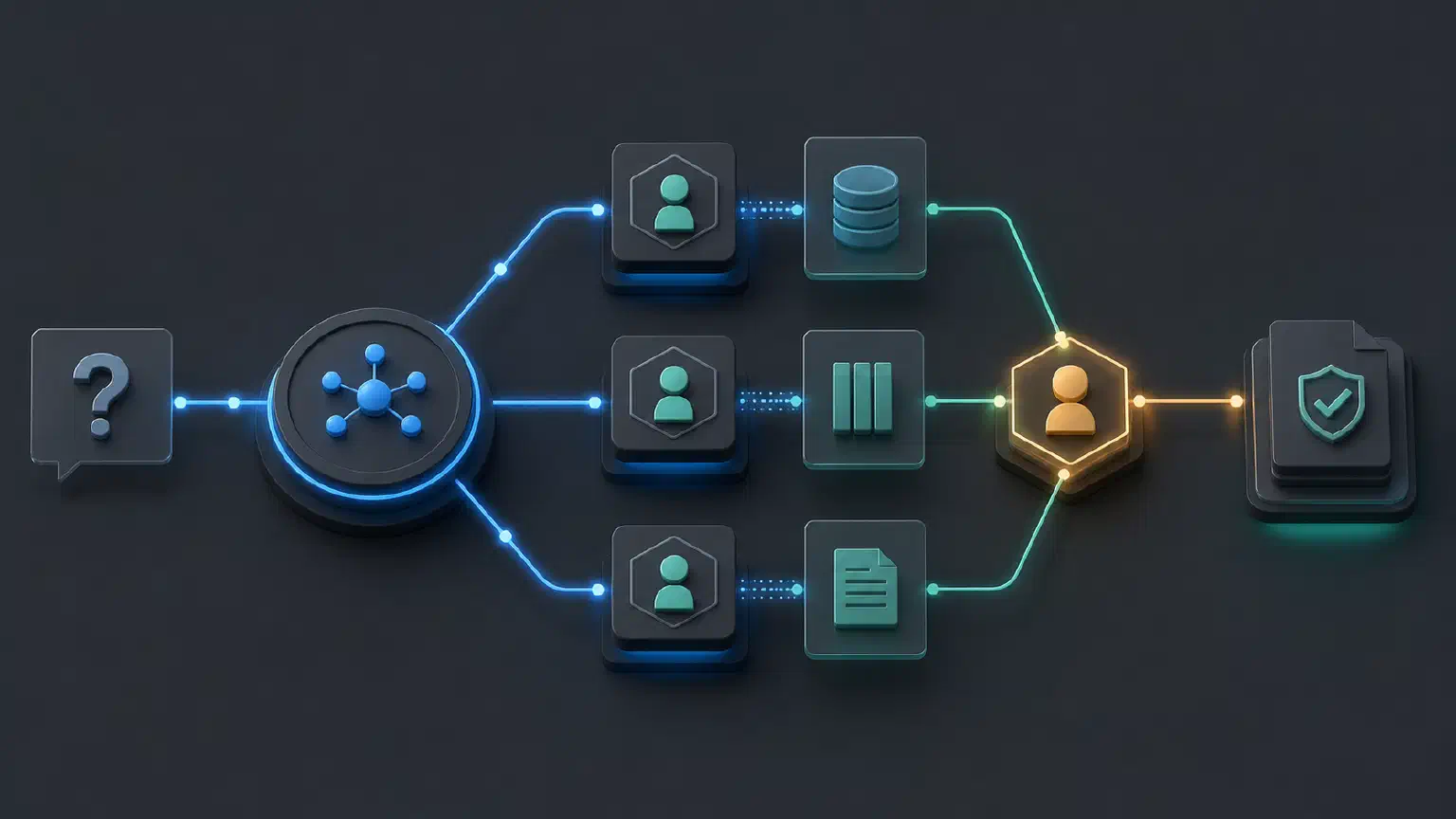
AI agent orchestration is the design of how agents, tools, data sources, and people coordinate to complete a job. It answers four operational questions: which component runs next, what context it receives, what happens when the result is incomplete, and who can approve the outcome.
For most enterprise teams, the right starting point is not a fleet of autonomous agents. It is a clearly defined workflow with the least coordination complexity that can handle the job. Use a deterministic chain when the steps are known, a single agent when one domain needs flexible tool use, and multiple agents only when the work genuinely divides into independent specialties or contexts.
That decision matters because orchestration adds more than capability. It adds routing, state, failure modes, permissions, traces, and cost. A system that looks impressive in a demo can be difficult to test when three agents disagree about a metric or one specialist sees data the final reviewer should not.
What orchestration controls
An orchestrator may be code, a workflow engine, a rule-based router, an LLM, or a combination. Its responsibility is broader than choosing a model. It coordinates:
- Routing: which agent, tool, or human receives the next step.
- State: the facts, definitions, intermediate results, and decisions carried between steps.
- Boundaries: the sources, tools, records, and actions available at each step.
- Quality gates: the conditions that allow a result to continue, retry, degrade, or stop.
- Accountability: the owner who reviews an exception or authorizes a consequential action.
OpenAI’s orchestration guidance distinguishes between letting the model decide the flow and determining the flow in code. It also separates “agents as tools,” where a manager retains control of the final answer, from handoffs, where a specialist takes over the conversation. Those are useful implementation patterns, but the business choice comes first: decide where control should remain visible.
Choose the simplest architecture that fits
The following progression is a practical decision model.
| Architecture | Best fit | Main tradeoff |
|---|---|---|
| Deterministic chain | Known steps, stable inputs, auditable transformations | Predictable but less adaptable |
| Single agent with tools | Varied questions within one domain | Flexible, but tool selection and stopping need controls |
| Routed specialists | Distinct domains or permission scopes | Modular, but routing and cross-agent state are harder |
| Parallel specialists with synthesis | Independent investigations that can be combined | Broader coverage, with more cost and reconciliation work |
Microsoft’s architecture guidance describes the same continuum, from deterministic chains through single-agent and multi-agent systems. Its recommendation to start simple is especially relevant for business data: every new branch creates another place for definitions, access rules, and evidence handling to drift.
Use a deterministic chain for fixed transformations
Suppose finance needs a weekly variance packet. The workflow always compares the approved plan version with actuals, calculates the bridge, retrieves the source records for the largest movements, and sends the packet to FP&A for review. The sequence is known. A coded workflow can enforce the order and reject missing inputs before an AI model writes commentary.
AI can still help explain a driver or summarize reviewed evidence. It does not need to decide whether the plan comparison happens before the actuals query. Keeping that part deterministic makes the workflow easier to reproduce and audit.
This is also the right default when a step changes business state. A model may propose a credit-limit adjustment or a customer message, but the system should make the approval boundary explicit instead of allowing an orchestration loop to decide that approval is unnecessary.
Use one agent when the domain is coherent
An operations agent investigating order exceptions may need to look at order status, inventory, payment state, and fulfillment notes. The questions vary, but the job has one owner and one connected domain. A single agent with a narrow tool set can choose which evidence to retrieve and ask a follow-up question when a record is ambiguous.
Set limits around that flexibility:
- Give the agent a defined job and output contract.
- Expose only the tools needed for that job.
- Set iteration, timeout, and token limits.
- Require structured results for downstream steps.
- Make missing or conflicting evidence a visible outcome, not an invitation to guess.
The four connection patterns for enterprise data are useful here. A live database query, a governed API, and document retrieval may all be appropriate, but they should be selected because the job requires them—not because the agent has access to a connector catalog.
Use routed specialists for real boundaries
Multiple agents become useful when the work crosses distinct domains, tool sets, or contexts. Consider a pre-forecast investigation that asks:
- a revenue specialist to inspect opportunity movement and close dates;
- a customer specialist to examine support and relationship signals;
- a delivery specialist to check implementation or product commitments.
A coordinator can route the request to one specialist, or ask several to investigate independently before a synthesis step. The important design question is not whether each specialist sounds expert. It is what each one is allowed to see and return.
The enterprise permissions guide recommends treating identity, tools, data scope, and approval as separate controls. Apply that principle to orchestration. A coordinator should not automatically inherit every specialist’s access. Each handoff should carry an explicit user or service identity, purpose, source scope, and output classification.
Pick an orchestration pattern by dependency
The number of agents is less useful than the dependency structure of the work.
Sequential: when each step depends on the last
Use sequential orchestration for a pipeline such as:
- classify the request;
- retrieve records from approved sources;
- calculate or validate the relevant metrics;
- draft an evidence-backed explanation;
- route the packet to a reviewer.
The next step should receive a defined output, not an entire conversation by default. That makes it possible to validate the boundary between stages. If the source-selection step returns no authorized records, the explanation step should not proceed as if the population were empty.
Microsoft’s sequential pattern guidance describes this as a predefined linear order and notes that it fits progressive refinement. It also warns against using it when stages need backtracking or dynamic routing. Add a retry or review lane deliberately; do not hide it inside an unconstrained agent loop.
Concurrent: when investigations are independent
Run specialists in parallel when they can answer separate questions from separate evidence without waiting for one another. For example, a customer-risk review might independently inspect product usage, open support issues, and commercial terms before a synthesizer compares the findings.
Parallelism is not free. The synthesis step must reconcile different time windows, entity identifiers, and definitions. Give every result a source list, as-of time, population, and unresolved limitation. Otherwise the final agent may turn three locally plausible findings into one globally misleading conclusion.
Anthropic describes this pattern in its multi-agent research system: a lead agent plans the research and parallel subagents explore different directions. The company also reports that multi-agent systems consume substantially more tokens than ordinary chat interactions and work best for breadth-first tasks with independent directions. That is a useful boundary condition, not a general argument for multi-agent adoption.
Handoff: when one specialist should own the next conversation
Use a handoff when routing is itself the main decision. A triage step might determine that a request belongs to finance, support, or revenue operations. The selected specialist then owns the response, context, and next questions.
Handoffs can reduce irrelevant context, but they can also make the path harder to reconstruct. Record the routing reason, candidate routes, selected specialist, and access scope. If the specialist cannot answer, return to a known escalation path rather than allowing agents to bounce the request among themselves.
Manager with specialists as tools: when one output must stay coherent
Use a manager pattern when a single agent must combine several bounded analyses into one answer or evidence packet. The specialists contribute findings, while the manager owns the format, completeness checks, and final response.
This is a strong fit for a governed business investigation. Each specialist can return claim-level evidence, but the manager must not silently resolve contradictions. It should flag disagreements, show the relevant definitions, and send the packet to the accountable owner when the decision is consequential.
Design the shared state before the prompts
Most orchestration failures are state failures disguised as reasoning failures. Before writing agent instructions, define the minimum state that should move through the workflow:
- request and requesting identity;
- business job and decision owner;
- entities and population under review;
- metric definitions and time boundaries;
- approved sources and data freshness;
- intermediate findings with evidence references;
- unresolved conflicts and missing data;
- permitted next actions and approval status.
Do not pass every agent the full transcript or every retrieved record. A smaller, typed handoff reduces accidental context leakage and gives reviewers a clearer audit trail. This complements the business-data context contract approach: definitions, lineage, time, permissions, and operational history should be explicit enough that the next component does not have to infer them.
For each handoff, define a contract such as:
Return the accounts in scope, the as-of time, the risk observations, the source records supporting each observation, and any missing or conflicting evidence. Do not recommend customer action.
That contract tells the next step what it can trust and what remains for a person to decide.
Put controls at the orchestration boundary
Controls should not depend on an agent remembering a paragraph of policy. Enforce them around the workflow:
- Before routing: authenticate the requester and determine the allowed business job.
- Before retrieval: apply source, record, and field-level scope where required.
- Before synthesis: validate schemas, freshness, entity joins, and required evidence.
- Before action: check authority, approval, idempotency, and the exact proposed change.
- After completion: store the outcome, evidence references, reviewer, and unresolved limitations.
The AI-agent observability model is a useful companion for this design. Trace the full run: route, tool calls, data scope, intermediate outputs, retries, reviewer decisions, and final state. A model trace alone cannot explain why a manager received an incomplete pipeline packet or why a restricted record appeared in a synthesis.
Evaluate the workflow, not the agent count
Test orchestration with cases that expose coordination risk:
- A normal request that should use the shortest path.
- An ambiguous request that should ask for clarification.
- A request spanning two domains with conflicting definitions.
- A stale or unavailable source.
- A user who lacks access to one relevant source.
- A specialist that times out or returns malformed output.
- A recommendation that requires human approval.
- A repeated request that should not duplicate an action.
Score the complete result: correct routing, authorized retrieval, evidence coverage, definition consistency, useful synthesis, predictable failure handling, latency, and cost. The AI-agent evaluation framework provides a broader task-specific scorecard for correctness, grounding, permissions, usefulness, and recovery.
For a first release, keep the output read-only or human-approved. Compare the orchestrated workflow with the current process on completed cases, including the cases that should stop or escalate. A successful pilot is not “the agents collaborated.” It is “the intended owner received a decision-ready packet with the right scope and a clear reason to trust—or challenge—each conclusion.”
When not to orchestrate multiple agents
Do not add specialists when one agent or a normal application workflow can do the job. Avoid multi-agent coordination when:
- the steps are fixed and easy to encode;
- every step requires the same context;
- there are many dependencies between agents;
- the job has low value relative to additional latency and model calls;
- no team owns the routing and failure paths;
- you cannot test the intermediate contracts;
- the system would need broad access just to make delegation convenient.
Complexity should earn its place. If a second agent does not create a meaningful separation of domain, context, parallel work, or responsibility, it is probably another failure surface.
A practical rollout sequence
Use this sequence for a first enterprise orchestration project:
- Choose one decision. Name the user, population, cadence, output, and accountable owner.
- Map the evidence. List the sources, definitions, freshness requirements, and permission boundaries.
- Build the shortest working path. Start with a deterministic chain or one agent with narrow tools.
- Add a specialist only for a demonstrated boundary. Document why a separate context or parallel investigation is necessary.
- Make every handoff typed and inspectable. Include evidence, scope, time, and limitations.
- Run shadow evaluations. Use closed cases and adversarial failures before changing live state.
- Operate with an owner. Review traces, exceptions, access decisions, and business usefulness on a fixed cadence.
Jovis is relevant when the goal is a governed agent around an actual business job: approved live sources, permission-aware access, grounded answers, and a shared workflow for recurring investigation. The architectural choice still belongs to the team. Start by testing whether one job can be made useful and inspectable; introduce orchestration only where the work demands coordination.
The decision to make
Enterprise AI-agent orchestration is not a maturity badge. It is a coordination design. Choose a deterministic workflow for known steps, a single agent for flexible work in one domain, and specialists for genuine separation or parallel investigation. Then make state, access, evidence, failure handling, and human authority explicit at every boundary.
The next practical step is to take one recurring business investigation and map its decision, sources, handoffs, and review point. Evaluate Jovis on that workflow to see whether a governed shared workspace can support the job without adding orchestration complexity that the decision does not need.