
 Jovis AI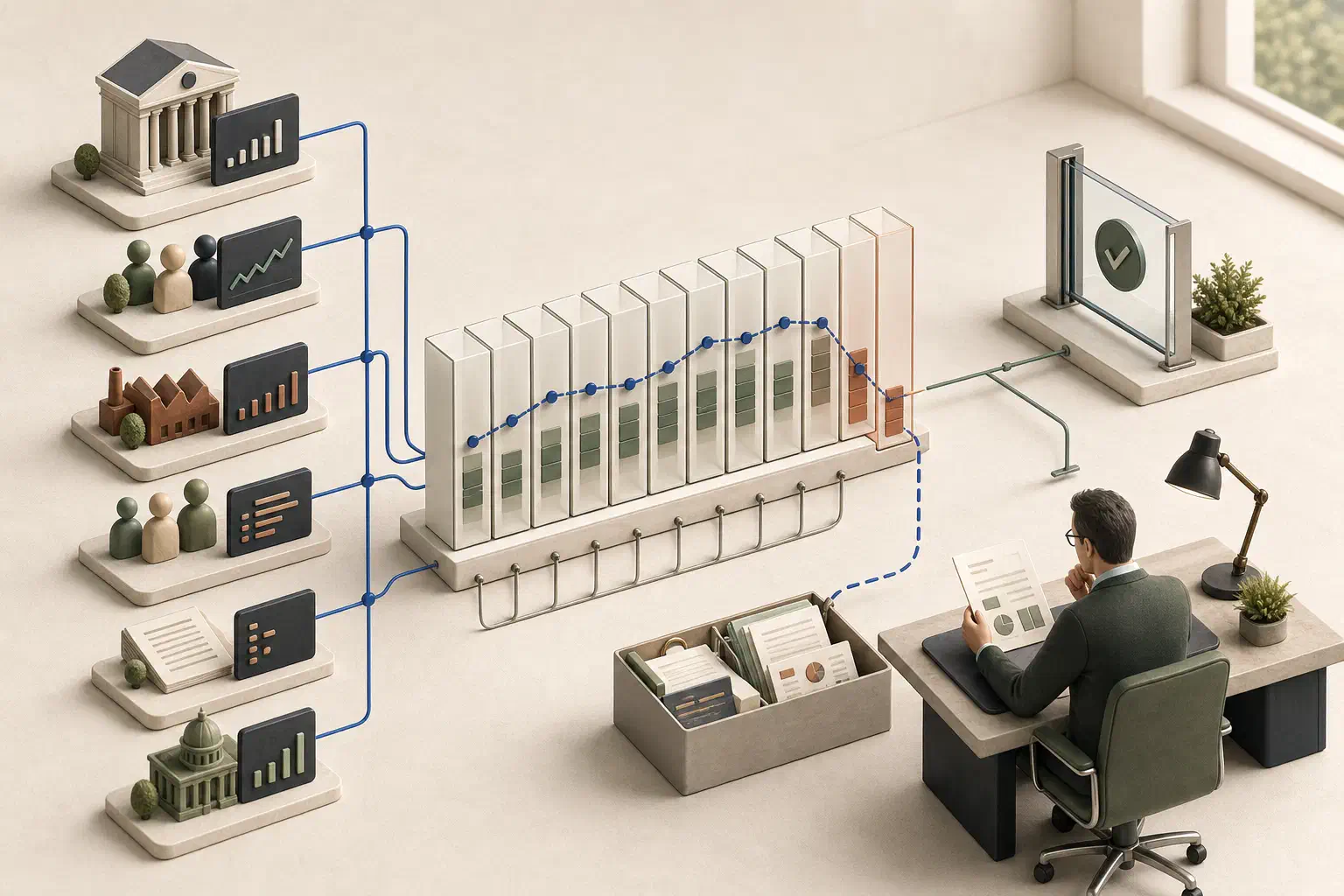
AI cash flow forecasting uses automation and AI assistance to estimate when cash will enter and leave the business. The calculations should remain deterministic. AI is most useful for gathering current context, testing timing assumptions, finding exceptions, and preparing explanations for a treasury or finance reviewer.
For a short-term forecast, that division is more dependable than asking a model to predict one closing balance. Treasury needs to know which receipts and payments produced the number, which assumptions changed, and where judgment entered. The output should be a rolling forecast with an evidence trail, not a confident line chart.
This guide is for treasury, FP&A, and finance-operations leaders building a read-first workflow around a 13-week cash forecast. The same controls apply to another horizon, but the source detail and acceptable uncertainty will change.
Start with the liquidity decision
A cash forecast should answer a defined decision. “Predict cash” gives the team no way to choose the right horizon, grain, or accuracy threshold.
A useful job statement might be:
Every Monday, update the 13-week direct cash forecast by legal entity and currency, identify material changes from the prior forecast, assemble evidence for uncertain receipts and payments, and route funding or operating questions to the treasurer. Do not initiate a transfer, change a payment date, or make a borrowing decision.
The Association of Corporate Treasurers describes operational cash forecasts as short-term views that generally cover the next 13 weeks on a rolling basis. It also notes that the appropriate update frequency depends on the business and its circumstances. That makes 13 weeks a useful operating convention, not a universal rule. See the ACT’s cash-flow forecasting guidance.
Choose the horizon from the decision:
- Use days when treasury must fund accounts or manage immediate settlement risk.
- Use weeks for near-term liquidity, collections, disbursements, and facility headroom.
- Use months or quarters for capital planning, where the forecast will rely more heavily on scenarios and business drivers.
Do not force these views into one accuracy target. A forecast used for tomorrow’s payments needs different evidence from a forecast used to discuss next quarter’s financing options.
Write a forecast contract before connecting systems
The forecast contract records what the number means and who can change it. It also prevents a new workflow from inheriting undocumented spreadsheet conventions.
| Contract field | What to define | Example control |
|---|---|---|
| Purpose | The decision the forecast supports | Manage weekly liquidity and facility headroom |
| Scope | Entities, bank accounts, currencies, and restricted cash | Exclude customer custodial accounts |
| Horizon and grain | Number of periods and level of detail | 13 weekly columns by legal entity and currency |
| Opening position | Authoritative balance, cutoff, and reconciliation status | Prior-day bank balance reconciled to approved cash accounts |
| Flow categories | Receipts, disbursements, financing, and transfers | Separate customer receipts from intercompany transfers |
| Timing rules | Due-date, behavior, settlement, and holiday assumptions | Adjust receipt dates using an approved customer payment pattern |
| Materiality | Which changes require investigation or approval | Review a defined amount or headroom breach |
| Ownership | Source owner, assumption owner, preparer, and approver | AR owns collection status; treasury approves forecast overrides |
| Evidence | Records required for each material adjustment | Invoice, payment history, owner note, and effective date |
| Versioning | Snapshot, cutoff time, and change history | Freeze the Monday forecast before scenario changes |
Keep the contract separate from financial-statement presentation. IAS 7 defines cash and cash equivalents and classifies historical cash flows as operating, investing, or financing. Those definitions can help reconcile management views to reported cash, but a 13-week operating forecast may need more actionable categories such as payroll, tax, collections, suppliers, and debt service. The IFRS Foundation’s IAS 7 overview provides the reporting baseline; finance should document how its forecast categories map to it.
Build from cash records, not the P&L
A short-horizon direct forecast starts with cash and expected cash movements. Revenue recognition and expense timing do not tell treasury when money will settle.
Map each forecast line to the smallest authoritative source set:
| Forecast component | Likely evidence | Question the workflow must answer |
|---|---|---|
| Opening cash | Bank statements, cash ledger, reconciliation status | Is this balance available, current, and in scope? |
| Customer receipts | Open receivables, invoice status, payment terms, collection notes, payment history | When is cash expected, and what supports a date change? |
| Supplier payments | Approved invoices, payment runs, purchase commitments, vendor terms | Which payments are scheduled, disputed, or optional? |
| Payroll and benefits | Approved payroll calendar and treasury funding request | What amount and settlement date are authorized? |
| Tax | Tax calendar and approved estimates | Which obligations fall inside the horizon? |
| Capital spending | Approved purchase orders, project schedules, payment milestones | Is the cash commitment approved and still timed as planned? |
| Financing | Facility terms, debt schedule, approved draws and repayments | What is committed, available, or subject to approval? |
| Intercompany flows | Approved settlement schedule and entity balances | Does the inflow in one entity match the outflow in another? |
Oracle’s current cash-forecasting documentation uses payables, receivables, payroll, external transactions, and prior-day bank statements as forecast sources. Microsoft documents a wider source model that can include ledger transactions, budgets, orders, inventory forecasts, projects, tax payments, and external data. These are useful examples of why an agent’s enterprise-data connection pattern should follow the forecast question rather than a connector catalog.
The model should not invent joins between an invoice, customer, bank receipt, and legal entity. Establish the identifiers, currency treatment, account scope, and allowed join paths before using AI to investigate a timing difference.
Separate calculation, estimation, and judgment
Use four layers so reviewers can see where uncertainty enters.
1. Reconciled opening position
Lock the opening balance to an approved cutoff. Record unreconciled transactions and unavailable accounts instead of treating the bank view as complete. If opening cash is wrong, every projected closing balance will be wrong by the same amount.
The workflow for AI-assisted account reconciliation shows the right boundary: apply matching rules first, then investigate the exceptions with supporting evidence.
2. Deterministic scheduled flows
Calculate known payroll, debt service, approved payment runs, contracted receipts, taxes, and transfers from explicit records and rules. Preserve the transaction identifier, amount, currency, date, source refresh time, and rule used.
AI does not improve arithmetic that finance can already reproduce. It may help find the record or explain why two sources disagree, but it should not silently replace the amount.
3. Evidence-backed estimates
Some cash dates remain uncertain. A customer may usually pay ten days after the contractual due date. A supplier invoice may be disputed. A project milestone may have moved without an updated purchase order.
AI can gather the approved context behind those cases and propose an estimate. Each proposal should show:
- the original amount and date;
- the proposed amount or date;
- the rule, pattern, or event supporting the change;
- the source records and their freshness;
- the owner responsible for the underlying cash flow;
- the reviewer and expiry date for the assumption.
The reviewer should be able to accept, change, or reject the proposal without editing a prompt. Material overrides belong in a versioned assumption register.
4. Named scenarios
Scenarios should change declared assumptions, not add an unexplained percentage to the closing balance. A downside case might delay a named group of large receipts, include a possible tax payment, or bring forward a supplier commitment. A funding case might add an approved facility draw with its fees and repayment effect.
Keep the base case separate. Label who approved each scenario and the decision it supports. Do not average mutually exclusive events into a number that nobody can interpret.
Review forecast changes as exceptions
The weekly review should focus on material changes, weak evidence, and approaching constraints. It should not require treasury to reread every forecast line.
Prepare an exception packet for each item that crosses a defined threshold:
- Movement: Show the current amount and timing beside the prior forecast and actual record.
- Driver: Identify the transactions and assumptions that produced the change.
- Evidence: Link the approved source records behind every material claim.
- Uncertainty: Separate observed facts from estimates and missing context.
- Consequence: Show the affected entity, currency, period, and liquidity threshold.
- Decision: Route one question to the role that can resolve it.
Consider a hypothetical example. The base forecast shows a cash low point in week six after a large customer receipt moves by two weeks. The invoice is open, but the collection note is stale and the customer’s usual payment pattern does not support the revised date. The useful output is not “liquidity risk detected.” It is a packet that shows the invoice, prior payment behavior, stale assumption, effect on headroom, and a question for the collections owner and treasurer.
That packet lets finance decide whether to update the base case, run a downside scenario, change the collection action, or prepare a funding option. AI prepares the investigation; it does not choose the response.
Close the loop with actuals and forecast versions
A rolling forecast should produce a new test every week. Freeze each approved version, load actual cash movements at the same grain, and explain the differences.
Use variance analysis with a reconciled driver bridge rather than scoring only the final balance. A correct closing balance can hide offsetting errors: receipts arrived late while supplier payments also slipped.
Track at least:
- absolute error by week and cash-flow category;
- directional bias, including repeated optimism in receipts or delay in payments;
- timing error versus amount error;
- forecast coverage, including accounts or entities that were unavailable;
- overrides by owner, reason, and age;
- material movements that lacked inspectable evidence;
- decisions reopened because a source or assumption was wrong.
Compare error by forecast horizon. Week one should usually face a tighter threshold than week thirteen. Avoid a single percentage metric when actual flows can be near zero or change sign; it can distort the result. Treasury needs to know which cash driver failed and whether better data, a better rule, or better judgment would have changed the decision.
The Association for Financial Professionals recommends defining the forecast’s goal, frequency, format, update schedule, accepted methods, variance analysis, and foreign-currency treatment in a forecasting policy. Its cash forecasting guidance also stresses cross-functional input and consistent assumptions. The forecast contract and weekly error review turn those principles into operating controls.
Keep treasury authority outside the agent
A cross-entity forecast can expose bank balances, payroll, customer payment behavior, supplier commitments, debt terms, and possible financing actions. Give the workflow only the accounts, fields, entities, and tools required for the forecast job.
Start read-only. The agent may prepare a proposed adjustment or funding question, but it should not:
- release or delay a payment;
- contact a customer or supplier;
- transfer cash between accounts;
- draw or repay a facility;
- change a forecast assumption without a recorded reviewer;
- present a scenario as an approved base case.
Test those boundaries alongside calculation and evidence quality. The business-data agent evaluation guide provides a practical structure for normal, ambiguous, forbidden, and failure cases.
Pilot one 13-week forecast through four weekly closes
In week one, define the decision, source scope, opening-balance control, categories, horizon, materiality, and owners. Reproduce the current forecast from a closed period before adding AI assistance.
In week two, automate deterministic scheduled flows and reconcile the result to the approved spreadsheet or treasury system. In week three, add evidence packets for a small set of uncertain receipts and payments. In week four, run the workflow beside the current process, freeze both versions, and compare actuals, overrides, missing evidence, and review effort.
Do not expand because the closing balance looked plausible once. Expand when treasury can reconstruct the forecast, explain material changes, enforce its authority boundaries, and learn from each forecast-to-actual cycle.
Jovis provides a governed workspace for agents working across approved business sources and shared context. In a cash-forecasting workflow, that workspace should support investigation and evidence while treasury retains assumptions, approvals, and liquidity decisions.