
 Jovis AI
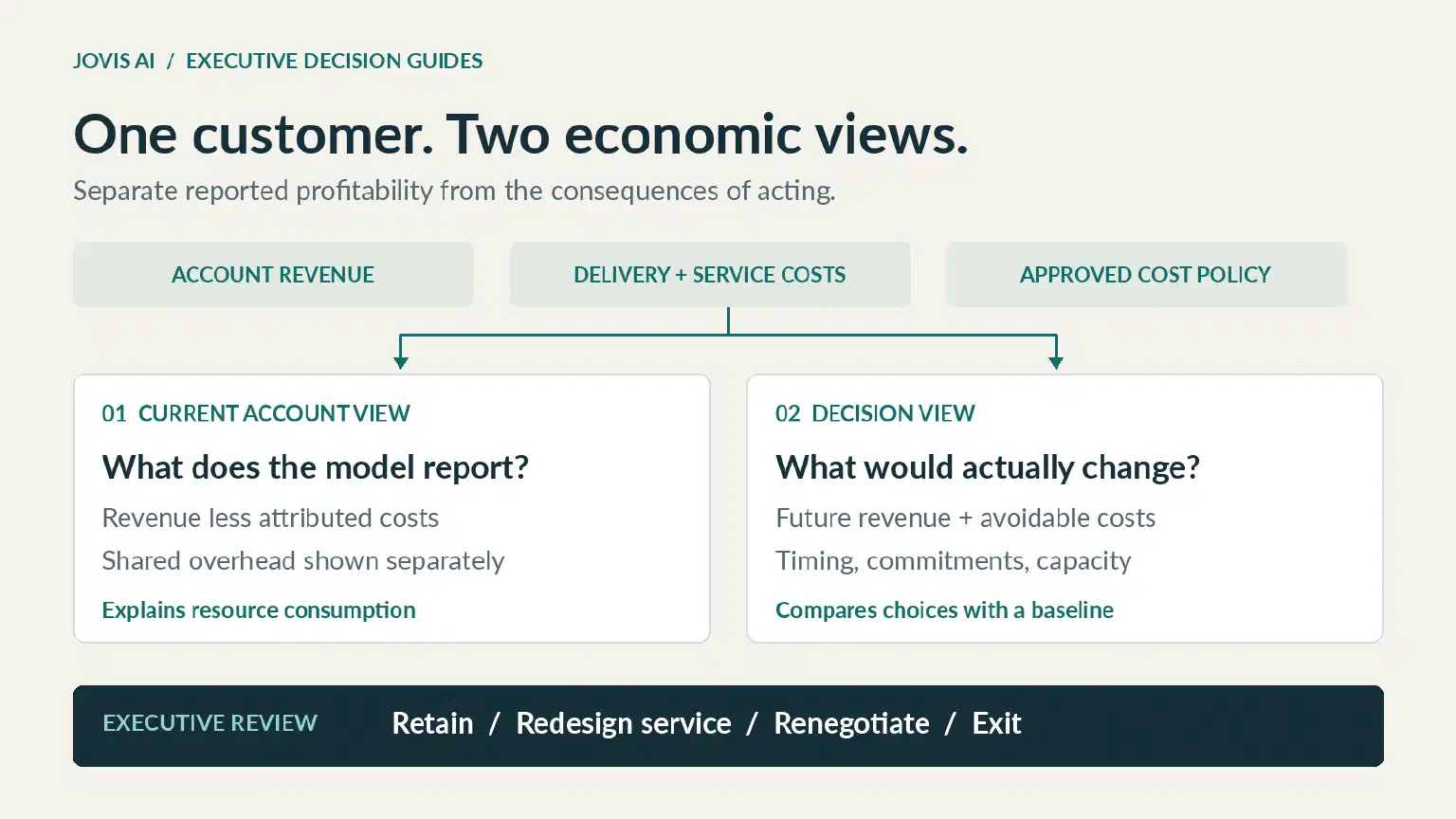
A large customer can meet its revenue target and still consume more service capacity than the commercial agreement supports. Before the next renewal, the CFO and commercial leader need to know whether to change the service model, revise the offer, invest in a fix, or keep the arrangement.
AI customer profitability analysis uses AI to help assemble and explain account revenue, delivery costs, and cost-to-serve evidence. Finance should retain the calculation rules and cost allocations. Executives should compare the future economics of each option before changing a customer relationship.
The essential distinction is between two questions: what profitability does the current costing model report, and what revenue or cost would actually change if leadership made a different decision? An account can look unprofitable after allocations while still making a positive contribution to costs the company will incur anyway.
This guide proposes a management workflow for B2B businesses. It is general implementation guidance, rather than a claim that Jovis provides a ready-made customer-profitability model or specific finance connectors.
Define the customer decision before ranking accounts
Choose a decision with a time horizon and an executive owner. For example:
Before renewing the managed-service accounts due next quarter, identify where delivery and support demands exceed the assumptions behind the offer. Compare maintaining the agreement, changing the service scope, and renegotiating at renewal. Finance validates the economics; the commercial leader owns the customer proposal.
That scope gives the analysis a purpose. A company-wide ranking from “best” to “worst” customer does not explain which costs are changeable, which commitments remain binding, or which relationships warrant investment.
Agree on the unit of analysis. A billing entity, parent account, contract, and product subscription can describe different economic relationships. If three subsidiaries share one implementation team, charging all its effort to the parent while counting only one subsidiary’s revenue creates a misleading result.
This decision also differs from neighboring reviews. Revenue leakage detection asks whether the business billed what it was entitled to bill. Customer profitability asks what remains after providing and supporting the service, even when every invoice is correct. A price change may follow, but it belongs in a separate pricing-strategy review that considers buyer response and commercial constraints.
Build two views of the economics
The first view explains current performance. The second compares a proposed change with a defined baseline. Keep them together so a report cannot quietly turn an allocation into a savings claim.
View 1: account profitability under an explicit costing policy
For an internal management view, start with revenue for the agreed period, subtract direct delivery costs, and then subtract customer-attributable service costs. Show shared overhead separately. Name each subtotal so readers can see what it includes.
Activity-based costing can help assign service costs using the activities that consume resources. ACCA’s activity-based management guidance applies this approach to customer profitability, including customer-service overheads that a product-level contribution measure can miss.
Choose drivers that describe actual resource use. Support handling time may be more informative than ticket count when case complexity varies. Implementation hours may explain more than customer revenue. Neither is automatically reliable: time records can be incomplete, and incident-wide work can be charged to multiple accounts.
This is a management model. The controller should approve its relationship to the company’s financial reporting and prevent costs from being counted twice.
View 2: incremental economics of a specific choice
For each option, ask what future cash flows would differ from maintaining the baseline. Record the timing, transition costs, commitments, and capacity consequences.
ACCA’s relevant-cost guidance distinguishes decision-caused cash-flow changes from existing fixed-cost reallocations. Moving a salary allocation from one customer to another does not, by itself, reduce payroll.
Released capacity can still be valuable. A specialist might serve another customer or remove a delivery bottleneck. Show that opportunity separately, with evidence of demand and available alternatives. Do not record hypothetical redeployment as a cash saving.
A worked example: the loss-making account worth retaining
The following figures are illustrative, not Jovis customer results. Assume a one-year renewal, no price change, and no replacement customer if the account leaves. All amounts are annual dollars.
| Current account view | Amount |
|---|---|
| Revenue | $240,000 |
| Direct external delivery costs | −$80,000 |
| Internal service labor attributed by activity | −$120,000 |
| Contribution after attributed service costs | $40,000 |
| Allocated shared overhead | −$60,000 |
| Result after shared overhead | −$20,000 |
The final row could prompt a recommendation to exit. That would skip the decision analysis.
Suppose finance confirms that the $80,000 external cost would stop if the account left, but only $20,000 of internal service labor would be avoidable during the next year. The remaining $100,000 of internal labor and all $60,000 of shared overhead would continue. Assume no exit fees or other changes for this simplified comparison.
Exiting would remove $240,000 of revenue and avoid $100,000 of costs. The company’s result would therefore worsen by $140,000 relative to renewal, despite eliminating an account reported as loss-making after allocations.
Now consider a service redesign. It requires a one-time $12,000 implementation expense and removes $18,000 of external delivery spending during the first year, without changing revenue. Its first-year incremental benefit is $6,000, subject to validating the service assumptions. If it also frees internal hours, record those hours separately until there is a credible plan to use or remove the capacity.
The appropriate executive discussion is about the redesign, the renewal terms, and alternative uses of constrained people. The reported loss remains useful evidence of resource consumption. It does not settle the customer decision.
Connect records without manufacturing precision
Start with a closed period and one renewal cohort. Before adding AI, finance and operations should agree on the following evidence map.
| Evidence | Definition or check required |
|---|---|
| Revenue, credits, and adjustments | Same period, entity, currency basis, and approved revenue definition; do not substitute cash receipts or contract value |
| Direct delivery spending | Account or contract reference; exclude amounts already included in another cost pool |
| Support and implementation activity | Handling time, case category, shared incidents, and missing time records |
| Account-management effort | Traceable activity where available; distinguish observed time from estimates |
| Service commitments | Executed scope, included support, exceptions, and effective amendments |
| Capacity and shared costs | Rate basis, practical constraints, allocation policy, and what can change within the decision horizon |
Assign a stable account identifier across these records. Unmatched costs should remain visible in an unassigned bucket until reviewed. Do not let a model quietly attach them to a similarly named customer.
Reconcile the included revenue and cost pools to finance’s approved totals, accounting for exclusions. Where the activity model leaves unused capacity, show it explicitly rather than forcing every dollar onto customers. Preserve the snapshot date and the allocation version so a later change in methodology is distinguishable from a change in account behavior.
Precision has limits. The Open University’s discussion of customer profitability describes the difficulty of tracing costs to individual customers and the approximation involved in indirect-cost allocation. Reflect that limitation in the output: an uncertain service-time estimate should produce a range or a request for validation, rather than a precise customer ranking.
Use AI to explain the drivers and challenge the story
Once the economic model is reproducible, AI can assist with work around it: locating relevant approved service notes, grouping recurring reasons for effort, finding contradictory evidence, and preparing questions for the account owner. These are proposed workflow roles to test, not guaranteed model behavior.
Keep the calculations in a finance-approved model. Ask AI to explain their inputs and surface gaps, without giving it authority to choose allocation rates, invent missing hours, or decide that a customer should leave.
An illustrative request might read:
Review the supplied profitability model for this renewal cohort. Explain the largest service-cost drivers using permitted case and implementation records. Separate recorded facts, estimated costs, and hypotheses. For each proposed change, identify which cost owner must confirm avoidability. Flag missing activity, conflicting scope, and evidence that challenges the recommendation. Do not change prices, service entitlements, or customer records.
A useful output might say that repeated configuration work accounts for much of the recorded implementation effort, while noting that the contract includes that work and the time log covers only part of the period. It should not convert those observations into “charge the customer more.” The commercial owner may discover a product defect, an unclear handoff, or a service promise that the original offer deliberately funded.
Give reviewers a short decision page with the current economics, the main drivers, data gaps, comparable options, expected cash changes, capacity effects, and an owner for each assumption. Keep source detail available behind it. Executives should be able to inspect a disputed claim without navigating an entire chat history.
Test whether uncertainty changes the recommendation
Before using the review in a renewal meeting, vary the assumptions most likely to reverse the conclusion: service hours, labor rates, future usage, transition spending, and the cost actually avoidable within the chosen horizon.
If a modest change in estimated handling time reverses the ranking, the right next step may be better measurement. If every reasonable scenario favors redesign, leadership has a stronger basis for authorizing a bounded service test.
Replay difficult cases as well as clean accounts:
- A parent account pays while subsidiaries generate the service activity.
- A shared incident creates many tickets but one engineering fix.
- One-time onboarding work distorts a short measurement period.
- A cost rate changes without any change in service consumption.
- Restricted contract terms are unavailable to the requester.
- Missing time records make the apparent low-cost account unreliable.
Require the workflow to expose these conditions and withhold unsupported conclusions. The data-quality control plan for AI agents provides a broader method for deciding when incomplete or conflicting sources should block a run or limit its output.
Leave the renewal meeting with a decision and a learning plan
The CFO validates the economic comparison. Operations confirms whether the proposed service change is feasible and whether capacity can actually be released. The commercial leader owns the relationship and any proposal. Appropriate contract or legal reviewers assess changes to existing obligations.
Record the selected option, rejected alternatives, uncertain assumptions, and the date to compare expected changes with actual results. Track reviewer corrections, unresolved cost attribution, and whether the proposed savings materialized. A faster narrative is useful only if it reduces the work needed to reach a defensible decision.
Jovis describes its role as finding relevant context across company systems and preparing leaders for decisions. Customer profitability illustrates why that context matters: finance, service delivery, and the customer relationship can each tell a different part of the story. The costing model and executive authority still need explicit owners.
For the first review, select one renewal cohort whose economics the team can independently reconstruct. Use it to test whether AI helps leaders challenge the explanation and compare the choices, while preserving the distinction between reported profitability and the consequences of acting.