
 Jovis AI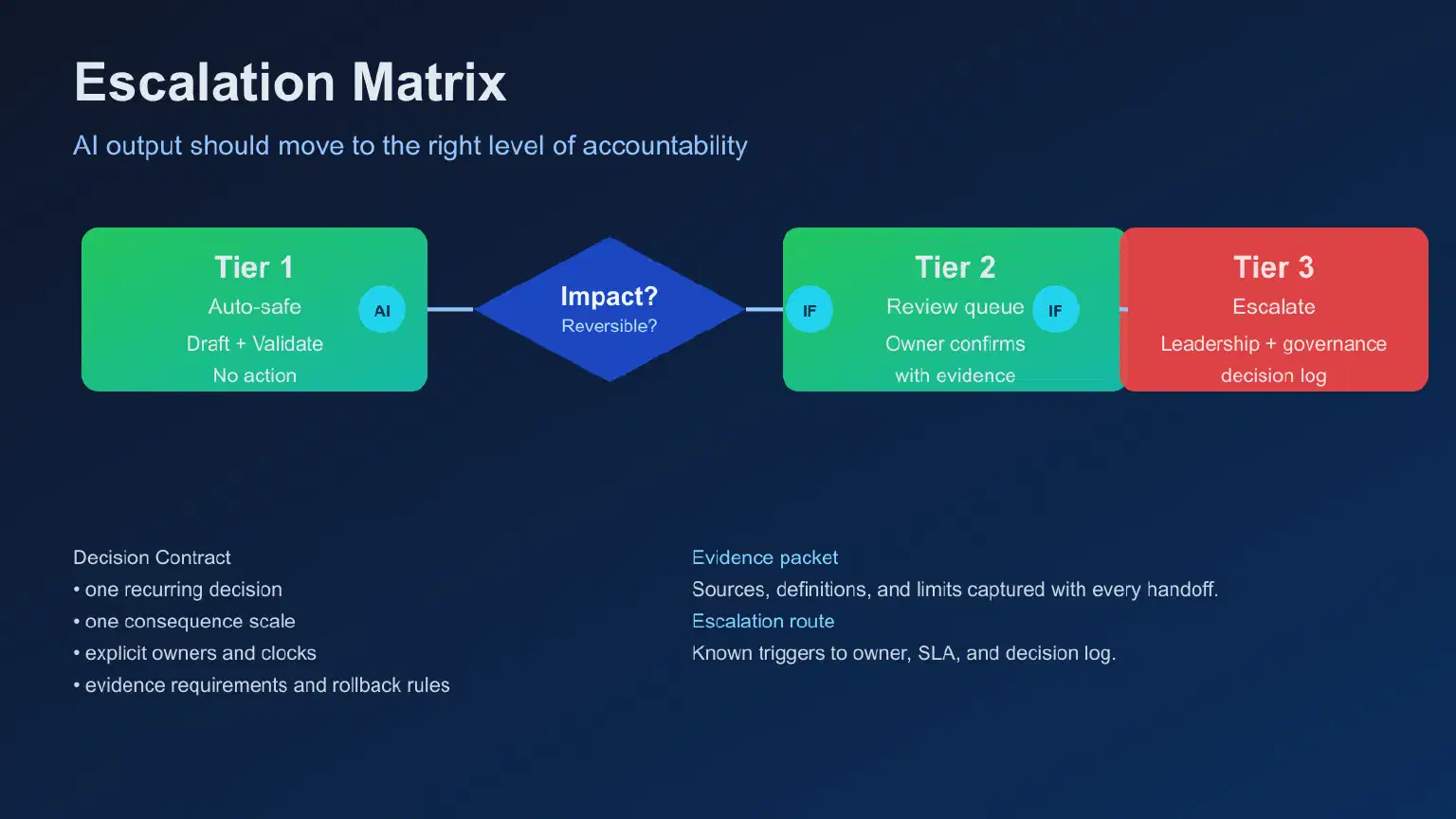
When AI helps with business-data operations, the first real design decision is not the prompt and not the model. It is escalation policy.
If an AI workflow can say it is done but there is no explicit path for escalation, the team is not building AI assistance; it is building a fragile automation shortcut. The right design is straightforward: define where each output goes—auto-safe, human review, or escalation—and enforce that routing every run.
This is an implementation guide for teams that want AI to shorten repetitive interpretation work without increasing operational risk.
Start with one decision, not one capability
Teams often begin with “AI should help us analyze invoices,” “AI should review tickets,” or “AI should flag pipeline risks,” and only later decide what gets pushed up to people. That sequence creates disputes and late rework.
Start from one decision that already exists today, and bind the AI to that decision. For example:
Every Friday, deliver a concise exception packet for supplier-risk flags that could require a finance or procurement action. Do not close supplier exceptions autonomously; only propose actions and required evidence.
That contract gives the escalation policy a fixed endpoint. It also prevents the workflow from growing into a general-purpose assistant for anything that looks “interesting.”
The decision should include:
- what question the workflow answers,
- the action boundary (insight, recommendation, or execution),
- the owner who will receive escalations,
- the time window for response,
- the minimum evidence needed for review.
If you cannot write that in a few lines, you are not ready to automate.
Use a decision matrix, not confidence thresholds alone
A common anti-pattern is to escalate based mainly on model confidence. Model confidence is one signal. For business data, a more stable policy starts with consequence.
Use three dimensions together:
- Business consequence: What is at stake if the output is wrong (money, compliance, customer commitments, production reliability)?
- Irreversibility: Can a wrong action be rolled back safely?
- Evidence quality: Are source, lineage, and context complete enough for review?
Escalation should happen when any of these dimensions crosses the policy threshold. Confidence scores are useful for triage speed, but they should never be the only decision trigger.
This is aligned with the NIST AI Risk Management Framework, which frames trustworthiness as a lifecycle process with continuous mapping, measurement, and management—not a one-off prompt quality check.
Build a reusable escalation contract
Write the contract before connecting systems.
| Field | What it defines | Why it matters |
|---|---|---|
| Workflow purpose | One decision and one output class | Prevents scope drift and accidental full-automation |
| Consequence levels | Low, medium, high impact definitions in business terms | Stops uncertainty from collapsing into one generic queue |
| Approval threshold | Exact decisions and actions that require human approval | Keeps accountability explicit |
| Evidence minimum | Required records for each consequence level | Prevents “I think” outcomes from entering reviews |
| Escalation threshold | When to stop auto-review and route upward | Avoids queue collapse under normal load |
| Owner per level | Named reviewer for each escalation tier | Removes role ambiguity |
| Clock rules | Acknowledgment and response SLAs | Keeps decision delays visible |
| Non-negotiables | Actions never allowed without additional checks | Preserves governance boundaries |
Store the contract as a versioned artifact with the workflow itself. The contract should be readable by operators and auditable by governance owners.
Define escalation tiers by consequence, not department
A practical pattern uses three tiers. Most teams can start here and refine later.
Tier 1: auto-safe outputs
Use when the business consequence is bounded, reversible, and evidence is complete. Typical outputs:
- drafting templates,
- grouping repeated records for review,
- calculating a metric with deterministic rules and no action attached.
All Tier 1 outputs should include source references so reviewers can validate later. Auto-safe does not mean “unreviewed forever”—it means “no human decision required to proceed.”
Tier 2: human-in-review outputs
Route here when consequence is material or the workflow crosses a policy boundary.
Examples:
- exception packet includes unusual assumptions,
- data appears stale,
- policy says a human should approve the recommendation,
- the action changes planning assumptions or customer commitments.
The human reviewer should receive:
- the proposed interpretation,
- explicit evidence IDs,
- a confidence window with known gaps,
- and the exact business question the recommendation is intended to answer.
Tier 3: escalation to wider ownership
Escalate when an output affects irreversible outcomes or unresolved risk.
Examples:
- likely financial or legal exposure,
- significant customer-risk indicators across multiple systems,
- repeated policy exceptions,
- no reliable owner for a proposed action.
Tier 3 should include a clear timeout rule, a named approver, and a decision log entry before any corrective action occurs.
The same pattern appears in AWS Well-Architected guidance for escalation paths, which recommends defining ownership and escalation rules in runbooks before incidents hit production operations.
Build escalation lanes into the workflow itself
Escalation logic must be in the workflow orchestration, not in operator discipline. Put it directly into the process by using deterministic routing rules.
A useful starting map:
- Input check: verify snapshot, schema, and required fields.
- Impact classification: assign consequence and reversibility levels.
- Evidence completeness check: verify minimum source proofs are present.
- Tier assignment: auto-safe, human review, or escalate.
- Ownership route: assign to named reviewer/owner.
- Response deadline: track SLA and escalation deadline.
- Decision capture: record action and rationale for audit and learning.
This structure keeps people from reinventing exception handling during the heat of an operation.
Tie escalation rules to your governance stack
Escalation is governance in motion.
If your policy does not already define access and oversight roles, build that first. AI permissions and access control describe why access boundaries should not become an afterthought. AI governance checklist helps you keep decision ownership from diffusing into “someone should handle it” ambiguity.
For teams still improving trust in AI answers, pair escalation design with trusted AI answer standards. Your escalation policy becomes stronger when every escalated record already carries:
- approved source references,
- business definitions,
- versioned context,
- known uncertainty limits.
NIST incident handling guidance also emphasizes prioritization and role-based procedures rather than first-come-first-served handling. NIST SP 800-61r2 repeatedly stresses that prioritization should be based on functional impact, information impact, and recoverability.
Practical implementation pattern for your first 60 days
Days 1–7: define and freeze the first contract
Choose one decision and one exception class. Include the four required fields in every contract entry:
- consequence,
- owner,
- evidence minimum,
- escalation threshold.
Do not scope creep. Keep it small.
Days 8–20: stand up deterministic routing
Add routing rules where the workflow currently drops all findings into one queue. Start with one evidence pack template and one escalation reason taxonomy.
Track only these initial KPIs:
- percent routed to each tier,
- time to first reviewer action,
- number of escalations reopened due to missing evidence.
Days 21–45: remove one known anti-pattern
Most teams escalate everything at first. That is a temporary state, not a design. After two pilot cycles, identify one anti-pattern and fix it deliberately:
- Policy-overload: too many generic escalation criteria.
- Reason drift: owners change without contract updates.
- Evidence drift: required records not consistently attached.
Then tighten rules and repilot.
Days 46–60: formalize the escalation runbook
Publish a short runbook with:
- route map (from Tier 1 to Tier 3),
- owner matrix,
- timeout escalations,
- rollback rules,
- review cadence.
Use the runbook as the source of truth for future workflow expansion.
Keep the decision culture enforceable
Escalation policy only works when people can trust it:
- Reviewers must have enough authority to act or they will just defer decisions.
- Approvers need complete packets or they will delay everything.
- Executives need summarized exception outcomes with clear decisions taken or deferred.
If your reviewer path collapses into silent delays, either the escalation threshold is too low, the evidence packet is missing fields, or ownership is unclear.
Escalation is not a tax on speed if it is bounded. It is the mechanism that lets teams gain speed on routine interpretation while preserving decision quality on high-impact outcomes.
CTA
If you are ready to pilot escalation-first AI operations, start with one recurring, high-impact workflow and apply the matrix above end-to-end. Then use Jovis to test that same workflow in a governed workspace.
Try it now: Evaluate Jovis on one escalation workflow — run one exception stream through a published escalation ladder, keep evidence attached at each tier, and compare decision quality after one operating cycle.