
 Jovis AI
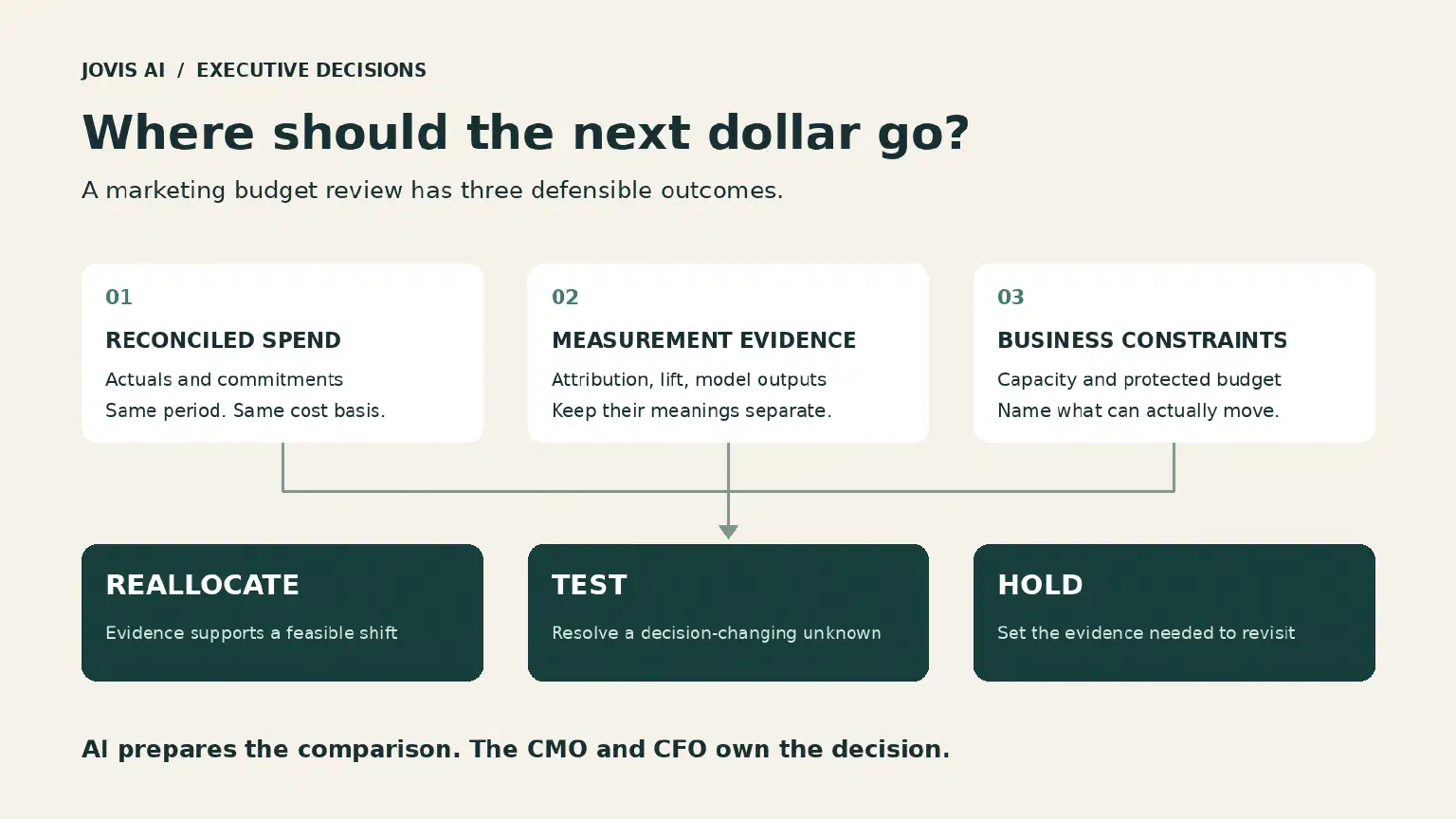
AI marketing budget allocation should help a CMO and CFO decide whether to move spend, fund an experiment, or hold the current plan. A useful workflow reconciles costs, distinguishes attributed results from incremental impact, and compares feasible options. AI can assemble and explain that evidence; qualified measurement specialists must validate the analysis, and executives retain spending authority.
The difficult moment is familiar: one channel reports a strong return while finance sees little movement in revenue. Another looks expensive but appears to reach customers the business otherwise struggles to acquire. Moving money toward the highest reported return feels decisive. It may simply reward the channel best positioned to claim credit.
This guide focuses on allocation within a marketing budget. The broader decision about how much capital marketing should receive belongs in the executive capital-allocation review. Here, the practical output is a short proposal that makes the evidence, uncertainty, and cost of a channel change visible before anyone approves it.
Agree on what the next dollar should achieve
Before asking AI to recommend a channel mix, the CMO and CFO should settle three questions.
Which outcome matters? New-customer revenue, qualified opportunities, contribution after variable costs, and renewal expansion are different objectives. Choose one primary outcome and name the secondary constraints. A proposal optimized for lead volume cannot be presented as a profit-maximizing decision.
Over what horizon? A campaign can create demand this quarter that converts later. Conversely, a strong current revenue result may reflect spending from an earlier period. Define the acquisition cohort, observation window, and expected delay before comparing channels. For a B2B business, distinguish opportunities created from opportunities that have had time to close.
What is actually movable? Deduct contractual commitments and protected spending before discussing reallocation. Record agency notice periods, campaign minimums, creative capacity, geographic restrictions, and sales follow-up capacity. A theoretical optimum outside those constraints is not an executable plan.
A useful mandate is specific: “Decide whether to move part of next quarter’s discretionary acquisition budget between two established channels, keeping total spend fixed and protecting the agreed experiment budget.” That leaves room for a decision without quietly reopening the entire growth strategy.
Keep attribution, experiments, and modeling separate
Three kinds of evidence can inform the discussion. Combining them into one unlabeled “AI score” removes distinctions the executives need.
| Evidence | Useful question | Boundary to preserve |
|---|---|---|
| Attribution reporting | Which interactions receive credit under our reporting rules? | Credited conversions do not establish how many outcomes advertising caused. |
| Incrementality experiment | What changed because the tested advertising ran? | The result applies to the tested population, intervention, and period; broader application needs justification. |
| Marketing mix model | How might outcomes respond to different spending patterns? | Estimates depend on the model, data, assumptions, and conditions represented in the analysis. |
Google Ads explicitly distinguishes standard attributed conversions, which follow configured attribution rules, from Conversion Lift estimates based on treatment and control groups. Its Conversion Lift measurement documentation provides a concrete explanation of that difference. An attribution report can help explain the recorded customer journey without answering the causal budget question.
A marketing mix model can support scenario comparison across channels. Google’s Meridian documentation describes fixed-budget and flexible-budget optimization scenarios, including scenarios constrained by target overall or marginal return. These are analytical capabilities of Meridian, not Jovis feature claims.
The executive distinction is between average return on past spending and expected return on additional spending. A channel with a high average return may offer a weaker next opportunity if its most responsive audience is already reached. Ask the measurement owner to explain the expected effect of the proposed change, rather than ranking channels solely by historical averages.
Do not commission a complex model solely to make an AI initiative look complete. Where spend variation, history, or outcome volume cannot support a defensible analysis, a bounded experiment or a decision to wait may be more useful. The measurement specialist should explain what the available evidence can identify.
Reconcile the business facts before generating recommendations
Give the workflow a small set of approved inputs with named owners:
- Finance: actual spending, accruals, commitments, currency treatment, and the approved budget version.
- Marketing: campaign and channel mappings, attribution settings, media delivery, and changes to creative or targeting.
- Revenue leadership: agreed customer or opportunity definitions, cohort maturity, and sales-capacity limits.
- Measurement: reviewed experiment results or model outputs, their applicable populations, assumptions, and uncertainty.
Keep media spending distinct from agency, production, and tooling costs. State whether each cost changes under the proposal. Avoid comparing one channel’s media-only return with another channel’s fully loaded economics.
AI should flag mismatched periods and missing definitions rather than invent a reconciliation. For example, a platform may report spend by delivery date while finance records an invoice in the following month. The workflow needs the approved treatment, not a plausible generated explanation. The FP&A variance-analysis guide explains how to lock versions and reconcile comparisons before drafting commentary.
Use approved aggregates where they answer the decision. A channel-budget review rarely needs every customer’s email address or the contents of private sales messages. Source owners should approve the intended use and audience, with privacy and legal specialists reviewing sensitive data use where relevant.
Compare reallocation, testing, and holding the plan
Consider a hypothetical B2B software company with a $600,000 quarterly marketing budget. Of that, $450,000 is committed or protected, leaving $150,000 for discretionary decisions. The CMO proposes moving $30,000 from paid social to paid search because search reports a higher attributed return.
Those figures define a choice; they do not establish a benefit. The review should examine three options.
Reallocate the $30,000
Require evidence about the additional search spending and the consequences of reducing social. Are the estimates for the same market, outcome, and period? Does search have room to absorb the increase? Does the social reduction fall within a range the analysis can support? Can sales handle the expected opportunity flow?
If a specialist supplies scenario estimates, preserve the model version, assumptions, and uncertainty. Arithmetic should come from reviewed calculations. A language model should not turn a persuasive narrative into a response curve or invent an expected revenue uplift.
Fund a bounded test
If the decision depends on whether social creates demand that later converts through search, write that uncertainty down. Ask the measurement lead to design a feasible experiment with an appropriate comparison, an outcome window, and stopping rules.
Do not prescribe a holdout percentage without understanding sample size, spillover, operational feasibility, and the cost of withholding activity. For a low-volume B2B business, the next quarterly review may arrive before the experiment can answer a closed-revenue question. The executives may need a longer horizon or a different decision.
Hold the allocation pending better evidence
Holding is defensible when cohorts are immature, tracking changed, or the proposed shift relies on assumptions the team cannot validate. Record the evidence needed to reconsider, its owner, and its expected availability. “Wait” should have a condition, not become a recurring postponement.
The important comparison is between feasible choices under uncertainty. A review that stops an unsupported $30,000 shift can be useful even when it produces no reallocation.
Use a one-page budget review template
The executive packet should fit on one page, with supporting analysis linked underneath. Copy this structure into the next CMO/CFO review:
- Decision: Amount, source and destination channels, market, effective period, and approval deadline.
- Objective: Primary business outcome, measurement horizon, and agreed economic definition.
- Movable budget: Total envelope, committed spending, protected amounts, and remaining discretion.
- Evidence: Reconciled actuals, cohort dates, attribution configuration, and applicable experiment or model results.
- Options: Reallocate, test, or hold; include incremental costs and operational consequences for each.
- Uncertainty: What is observed, estimated, or unknown; which assumption could reverse the choice?
- Authority: Recommending executive, finance reviewer, spending approver, and person responsible for execution.
- Review trigger: When outcomes can reasonably be assessed and what evidence would justify changing course.
Keep the primary recommendation and its largest unresolved question visible together. Supporting links should open the relevant calculation or source record directly, so reviewers do not have to navigate a document library to challenge one assumption.
Preserve the accepted choice in an executive decision log. In the next cycle, assess it against the conditions agreed at approval, including changed assumptions. Avoid judging a long-horizon investment solely on the first week’s reported conversions.
Give AI the preparation work and test its boundaries
An AI assistant can be evaluated on whether it locates approved evidence, spots incompatible definitions, compares reviewed scenarios, and prepares a concise explanation of disagreement. It should make an unsupported recommendation easier to challenge.
It should not fabricate missing campaign performance, claim that correlation proves impact, or silently treat an old model as a forecast for new conditions. Meridian’s future scenario-planning guidance specifically notes that historical assumptions may not fit future plans. It also distinguishes estimated incremental outcomes from a forecast of the total future outcome. That distinction belongs in the executive explanation.
Before using the packet in a live budget review, replay a completed planning cycle using only evidence available at its decision date. Include a channel mapping change, an incomplete cohort, a conflicting spend total, and a recommendation outside the approved budget. Check whether the workflow exposes each problem and preserves the original source and period. A polished memo that misses those conditions has failed the job.
Keep budget transfers, campaign edits, and commitments in the established approval systems. Evaluate preparation separately from spending execution. Measure reviewer corrections, reconciliation gaps, preparation effort, and whether the packet supports a clear decision. Any claim of improved marketing performance needs its own credible measurement design.
Carry decisions forward without freezing old assumptions
A future Chief of Staff experience could connect the CMO’s request, the finance constraint, the experiment owner, and the next review date. Shared memory would be useful because it preserves why a budget was protected and what evidence was meant to reopen the decision. This is a design direction, not a claim that Jovis currently runs marketing experiments or reallocates advertising spend.
Give remembered preferences owners and expiry dates. “Protect this launch budget through the quarter” should remain a dated constraint, not become a permanent instruction. The simple executive experience is a brief showing the proposed decision, the evidence that changed, and the question requiring approval.
Jovis’s current product positioning centers on finding relevant business context and preparing leaders for decisions. For this use case, the first evaluation should remain narrow: one real budget question, approved sources, and a CMO/CFO review of whether the prepared context makes the allocation easier to defend.