
 Jovis AI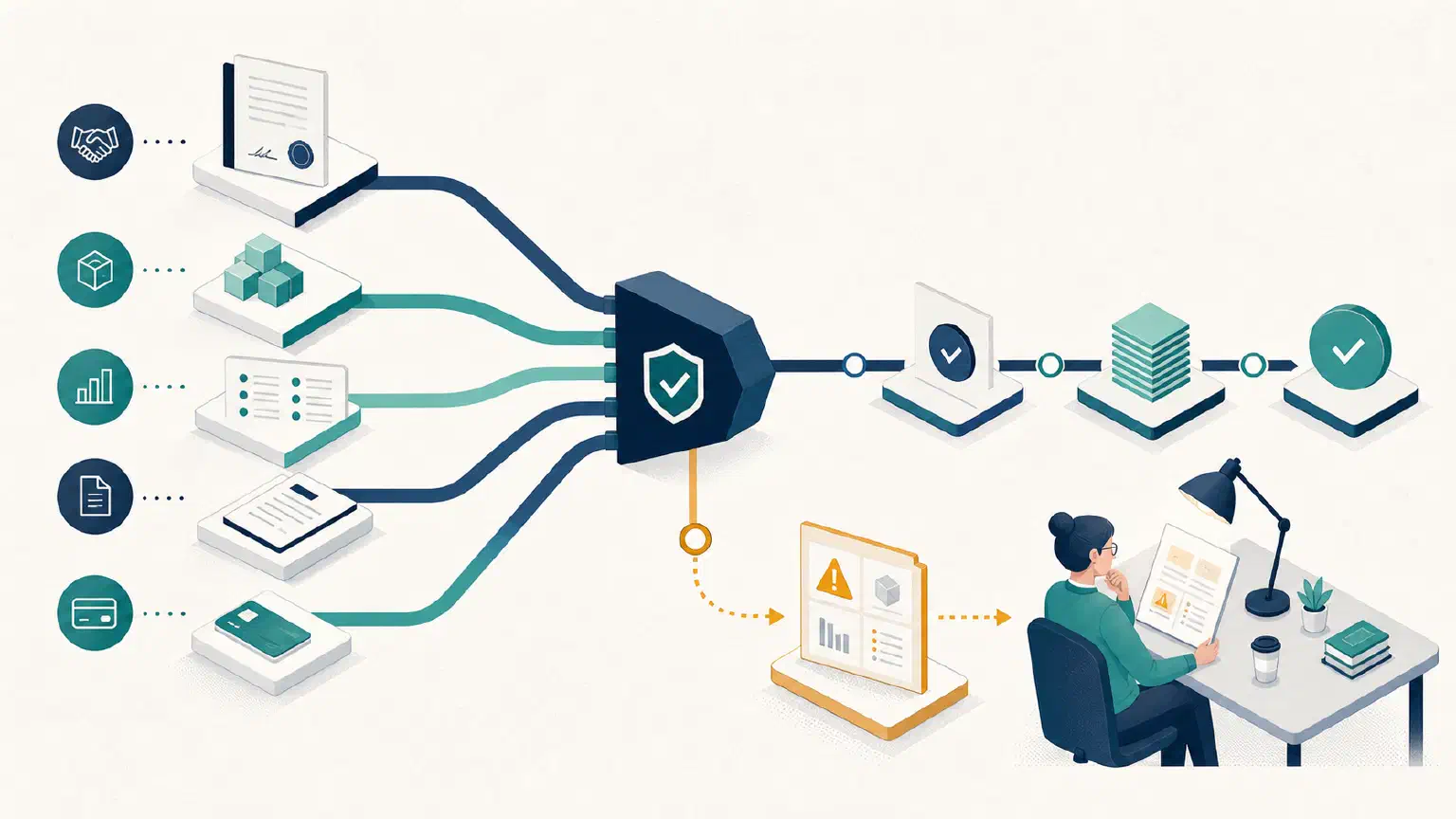
AI revenue leakage detection is a controlled process for finding cases where the amount a company is entitled to bill or collect differs from what reached the invoice and cash systems. Deterministic rules should calculate the mismatch. AI can help interpret variable commercial terms, gather evidence across systems, and prepare an exception for review. An accountable owner decides whether the finding is valid and what correction follows.
This is a quote-to-cash problem, not simply a failed-payment problem. Salesforce describes quote-to-cash as spanning configuration and pricing through proposals, agreements, orders, renewals, invoicing, collection, and cash allocation. A leak can enter at any handoff: an approved price does not reach billing, an entitlement starts without a subscription, usage is dropped, an escalator is missed, or an unsupported credit reduces the amount due.
The useful output is not a dramatic estimate of “lost revenue.” It is a small queue of reproducible exceptions, each with a dollar impact, supporting records, a named owner, and a permitted next step.
Start with one leakage contract
“Find every revenue leak” is too broad for a first workflow. Different revenue models create different control points, and a false allegation of underbilling can be costly to investigate or awkward to raise with a customer.
Choose one population and one mismatch. For example:
After monthly usage closes, compare approved enterprise API usage with billable meter events and draft invoice quantities for active usage-based subscriptions. Identify differences above the approved materiality threshold, assemble the source events and contract terms, and route each exception to billing operations. Do not alter usage, issue an invoice, contact a customer, or recognize revenue.
Write the contract before connecting systems:
| Contract field | Decision to record | Example |
|---|---|---|
| Population | Which customers, products, entities, and periods are included? | Active enterprise API subscriptions for the prior month |
| Entitlement | What establishes the right to bill? | Executed order form plus active service entitlement |
| Billable event | Which event, status, unit, and timestamp count? | Successful production request at completion time |
| Pricing | Which rate, tier, minimum, credit, or cap applies? | Customer-specific rate card effective on the event date |
| Comparison | Which two or more states must agree? | Approved usage, accepted meter events, and draft invoice quantity |
| Materiality | What enters the review queue? | Difference above the approved amount or event count |
| Evidence | What must support a finding? | Contract version, event IDs, meter summary, and invoice preview |
| Authority | Who may review, correct, approve, and contact the customer? | Billing operations reviews; controller approves a correction |
Do not mix all products and leakage types into the first contract. A fixed-fee subscription with annual escalation, a consumption product, and a professional-services milestone each need different logic.
Map the path from commercial intent to cash
A leakage review needs business states, not just system names. Map the evidence that establishes what should have happened and what did happen.
Commercial terms
Use the executed agreement, approved order form, amendments, rate cards, start and end dates, minimum commitments, discounts, and renewal terms. Separate signed terms from a sales proposal or an outdated CRM field. If contract language is ambiguous, route it to the appropriate commercial or legal owner rather than asking the model to settle the interpretation.
Entitlement and delivery
Confirm what the customer was allowed to use and what the business actually delivered. Depending on the offer, this may include provisioned seats, activated locations, completed milestones, shipments, or accepted product events. Maintain a stable customer, contract, product, and service-period key across these records.
Rating and billing
Record the meter configuration, aggregation rule, price version, invoice line, taxes where relevant, and invoice state. Usage systems have operational behavior that affects comparisons. For example, Stripe’s current usage-recording documentation says meter events process asynchronously, recommends unique identifiers to prevent duplicate reporting, and exposes errors for invalid events. A control should therefore distinguish a genuinely missing event from one that is still processing, rejected, or reported twice.
Credits and collections
Trace credit notes, write-offs, disputes, customer balances, payments, and cash application separately. A credit may be valid even when it reduces the billed amount. Stripe documents credit notes as records that decrease an open or paid invoice and retain a stated reason. The workflow should test whether the credit followed approved policy and evidence, not label every reduction as leakage.
This source map often exposes a more basic problem: the same customer or product has incompatible identifiers across systems. Fixing that join can be more valuable than adding a more elaborate model. The four architectural options in connecting AI agents to enterprise data help teams decide whether each part of the review should use a curated store, live query, document retrieval, or governed tool.
Keep matching deterministic and investigation flexible
Divide the workflow into three lanes.
Lane 1: expected matches
Use reproducible calculations to confirm the ordinary path. Examples include:
- active entitlement has the expected subscription and invoice line;
- accepted usage totals equal the rated invoice quantity under the approved aggregation rule;
- contract price and effective date match the billing price version;
- an approved credit maps to the correct invoice, amount, and reason;
- billed and collected amounts reconcile after valid credits, taxes, and timing items.
Store the calculation version, inputs, cutoff time, and result. Do not ask an AI model to add event quantities or decide which price table applies when governed code can do it consistently.
Lane 2: known exceptions
Encode approved timing and operational rules. Late-arriving usage, billing cutoffs, minimum commitments, free periods, proration, foreign exchange, disputes, and planned credits can create differences that are not leaks.
Rules must be specific enough to reproduce. “Billing timing” is not a useful disposition. “Usage arrived after the 23:00 UTC cutoff and is included in the next billing cycle under policy version 4” is reviewable.
Lane 3: investigation
Use AI where the evidence path varies: extracting a customer-specific clause, comparing an amendment with the active billing setup, locating the service event behind an invoice line, or summarizing why records conflict. Require the workflow to distinguish observations, calculations, hypotheses, and missing evidence.
This is where the method differs from account reconciliation. Reconciliation asks whether defined record populations agree under accounting and timing rules. Leakage detection begins with the commercial right to bill, follows it through operational delivery, and tests whether a billable amount was omitted or reduced without sufficient support.
Give reviewers an exception packet
An alert that says “possible underbilling” transfers the hard work to finance. Each finding should contain enough evidence to validate or dismiss it:
- customer, contract, product, entity, and service period;
- leakage control and materiality rule that fired;
- expected amount, observed amount, and reproducible difference;
- relevant contract clause or approved commercial term;
- entitlement, usage, invoice, credit, and collection records used;
- source timestamps and freshness at the run cutoff;
- known timing rules already tested;
- AI-assisted explanation, clearly labeled as a hypothesis where appropriate;
- missing or conflicting evidence;
- reviewer, due date, and allowed dispositions.
Useful dispositions include confirmed correction, valid timing difference, approved commercial exception, source-data error, duplicate finding, and unresolved. Capture the reason, not only the status. Those outcomes become the test set for improving the control.
Keep record access narrow. A reviewer may need invoice and contract detail for assigned accounts without receiving unrestricted access to every customer’s records. The controls in AI-agent permissions and access control should apply to the source query, retrieved documents, tools, and proposed action, not merely to the chat interface.
Separate finding, correction, and accounting decisions
Detecting a plausible mismatch does not authorize a backdated usage event, amended invoice, credit reversal, collection message, contract interpretation, or accounting entry.
Use explicit handoffs:
- The workflow prepares the finding and evidence.
- Billing operations validates the source records and calculation.
- The commercial owner resolves disputed terms when needed.
- The controller or delegated approver authorizes the correction under company policy.
- The customer-facing owner controls external communication.
- Finance determines the appropriate accounting treatment.
That separation makes the review slower than one-click “recovery,” but it prevents a weak model inference from becoming an unsupported customer charge. NIST’s AI Risk Management Framework Core calls for organizations to define human-AI roles, document oversight, and specify how outputs may be used. The appropriate boundary here is clear: AI assists investigation; people with the relevant authority make consequential commercial and financial decisions.
Test on closed periods before monitoring live revenue
Use two or three closed periods with known outcomes. Include clean matches, confirmed leaks, valid credits, late usage, amendments, renewals, cancellations, duplicate events, missing identifiers, and ambiguous terms.
Measure the workflow at the exception level:
| Measure | What it reveals |
|---|---|
| Population coverage | Whether eligible contracts and billing records entered the control |
| Confirmed finding rate | How much of the queue reviewers validate |
| False-positive rate | How often the workflow creates avoidable review work |
| Miss rate on known cases | Whether material historical exceptions were overlooked |
| Evidence completeness | Whether a reviewer can reproduce the result from the packet |
| Time to disposition | Whether an exception reaches the right owner while correction is practical |
| Repeat rate by cause | Whether the team fixes upstream process defects or keeps recovering the same issue |
Do not grade only the written explanation. Re-run the calculations independently, test permission boundaries, simulate stale or unavailable sources, and verify that the workflow refuses to conclude when necessary evidence is missing. The broader AI-agent evaluation framework provides test patterns for correctness, grounding, authorization, task completion, and recovery behavior.
Run a four-week controlled pilot
Week 1: define the control. Choose one product and leakage type. Agree on the population, commercial source, billable event, pricing rule, materiality, reviewer, and prohibited actions.
Week 2: reproduce the healthy path. Prove that identifiers, event totals, rates, invoice quantities, credits, and cutoffs reconcile for known-good accounts. Resolve source gaps before asking AI to explain them.
Week 3: replay exceptions. Test confirmed historical leaks and legitimate differences. Tune deterministic rules and require complete evidence packets. Review every finding.
Week 4: run beside the current process. Monitor one live cycle in read-only mode. Compare the workflow’s queue with the existing billing review, record dispositions, and decide whether to expand, revise, or stop.
The goal is not to produce the largest recovery estimate. It is to establish a reliable control that catches material exceptions early, shows why they occurred, and helps the business fix the upstream handoff that created them.
If this is a recurring review your team currently assembles across contracts, usage, billing, and finance systems, evaluate Jovis on one bounded revenue-leakage workflow. Keep the source scope, review authority, and acceptance criteria explicit from the start.