
 Jovis AI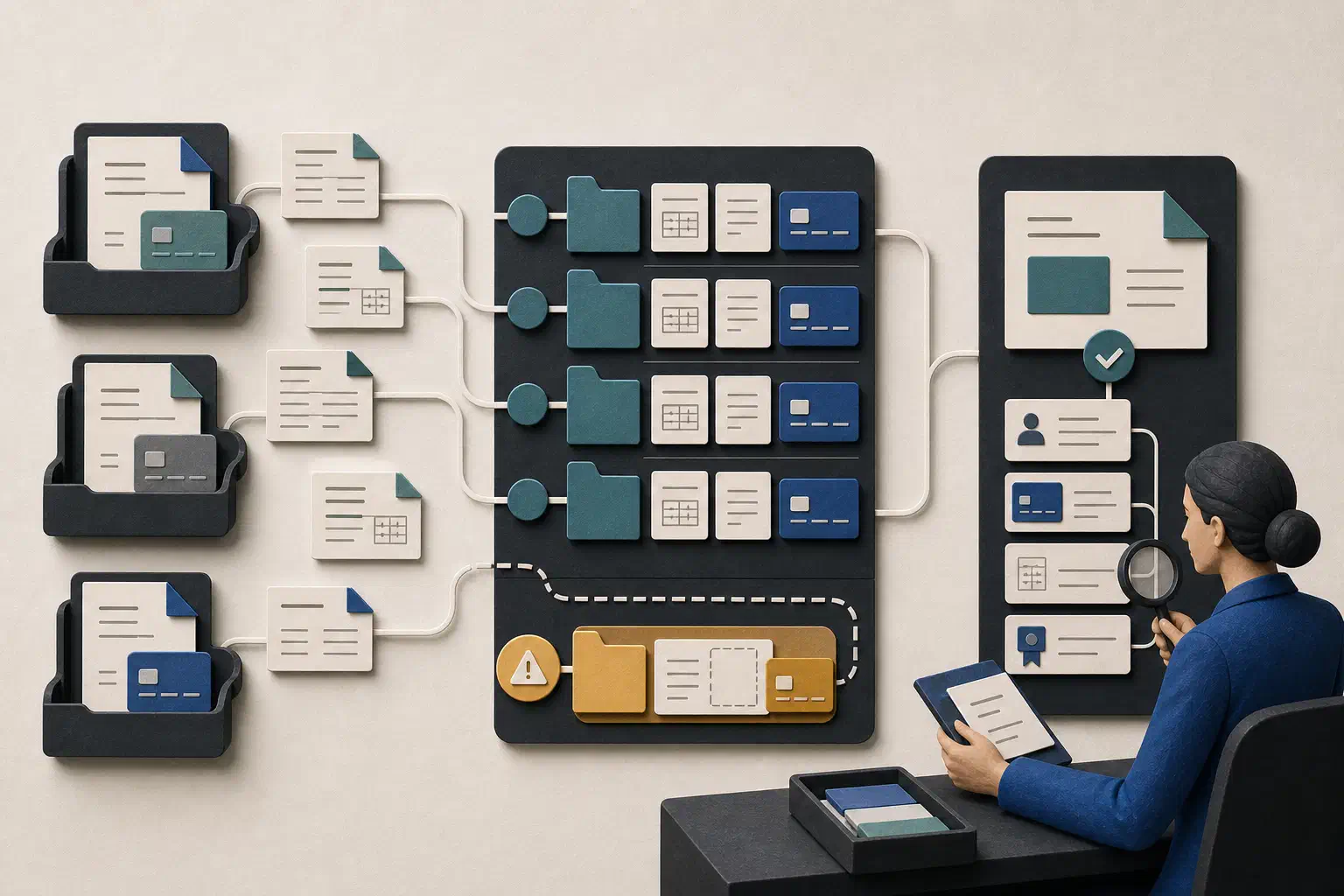
AI spend analysis uses automation to assemble purchasing records, normalize suppliers, classify spend, and help procurement teams investigate opportunities or control gaps. A controlled workflow keeps totals, joins, currency conversion, and policy rules deterministic. AI can assist with ambiguous descriptions, supplier research, and evidence gathering, but a procurement owner decides whether a finding is real and what action follows.
That boundary matters because a clean-looking spend cube can hide weak joins and confident guesses. “Software,” “professional services,” and “cloud infrastructure” may overlap in an invoice description. One supplier may appear under several legal entities. A payment may have no purchase order, while a contract covers only part of the spend. The useful output is a short queue of findings that a category owner can trace back to transactions, contracts, and approved definitions, without a speculative savings number attached.
This guide is for procurement, finance, and business-operations leaders designing a first AI-assisted spend review. It focuses on historical analysis and decision preparation, not autonomous purchasing or supplier negotiation.
Start with one procurement decision
“Analyze all company spend” is too broad for a pilot. Choose one category, business unit, or recurring review with a named decision owner.
A workable job statement might be:
Each month, review software and cloud spend for duplicate suppliers, purchases outside an approved contract, and material price variation. Prepare evidence for the category manager. Do not reclassify the source record, contact a supplier, or claim savings without review.
This statement defines the population, cadence, questions, reviewer, and action boundary. It also separates three different outcomes that are often mixed together:
- Data correction: two supplier records refer to the same legal entity, or a category is wrong.
- Control review: a purchase appears to lack the expected contract, approval, or purchase order.
- Commercial investigation: spend concentration, fragmentation, or price variation may justify a sourcing decision.
Each outcome needs different evidence and authority. A duplicate supplier record may go to procurement operations. A contract exception may need legal or finance review. A possible negotiation belongs with the category owner.
The U.S. Government Accountability Office describes spend analysis as an ongoing process of automating, extracting, supplementing, organizing, and analyzing procurement data. Its review of leading practices also emphasizes accurate, complete, consistent files and logical supplier and commodity categories. Although the report predates modern AI systems, its spend-analysis process remains a sound control model: build a reliable spend population before asking for recommendations.
Write a spend contract before connecting systems
A spend contract records what the analysis includes and how the workflow will calculate it. Without one, reviewers can disagree about the total before they reach the procurement question.
Define at least these fields:
| Contract field | What to decide | Example review question |
|---|---|---|
| Population | Legal entities, business units, categories, and transaction types | Are employee expenses and purchasing cards included? |
| Grain | Invoice, invoice line, purchase-order line, payment, or expense line | Can one invoice contain several spend categories? |
| Spend date | Order, receipt, invoice, posting, or payment date | Which date assigns spend to the quarter? |
| Amount | Gross, net, tax-inclusive, committed, or paid amount | Are credits and refunds netted against the original category? |
| Currency | Source currency, reporting currency, and conversion rule | Which rate and date are used for conversion? |
| Supplier identity | Legal entity, parent, trading name, and location | Should two subsidiaries roll up to one supplier group? |
| Category | Internal taxonomy, external standard, or both | Who owns an ambiguous classification? |
| Coverage | Known exclusions, late records, and inaccessible systems | What share of the intended population is present? |
Retain the raw identifiers and original values beside every normalized field. A cleaned supplier name should not erase the source vendor ID. A converted amount should retain the source currency and rate. An AI-suggested category should carry the model or rule version, confidence band, and review state.
Map evidence from transaction to decision
Accounts payable data can answer how much was invoiced. It rarely answers every procurement question. A category review may also need purchase orders, requisitions, contracts, supplier master data, expense cards, receiving records, budgets, and approved exceptions.
Map sources to claims rather than putting every field into one undifferentiated table:
| Claim | Likely authority | Supporting context |
|---|---|---|
| Amount invoiced | Accounts payable or invoice ledger | Credit notes, taxes, currency |
| Amount ordered | Purchase-order system | Change orders, cancellations |
| Supplier identity | Governed supplier master | Parent relationship, active status |
| Contract coverage | Contract repository or approved contract API | Effective dates, entities, covered items |
| Receipt or delivery | Receiving or service-acceptance record | Partial receipt, disputed delivery |
| Approval status | Procurement workflow | Policy exception and approver |
| Business purpose | Requisition or expense record | Requester, cost center, description |
Stable keys matter. The World Bank’s guidance on procurement data analytics recommends connecting stages of the procurement cycle through consistent identifiers and improving data quality with automated checks and periodic audits. The same principle applies inside a company: do not infer that an invoice belongs to a contract merely because supplier names look similar.
The connection pattern should fit each source. The guide to connecting AI agents to enterprise data compares live queries, synchronized stores, indexed documents, and governed tools. Spend totals may come from structured records, while a contract clause may need retrieval from an approved document collection. Preserve the source and refresh time for both.
Separate deterministic controls, AI assistance, and human judgment
A production workflow should make these lanes visible.
Deterministic controls
Use code or approved business rules for arithmetic, exact identifiers, date windows, currency conversion, duplicate transaction checks, and known policy thresholds. These steps should return the same result when the inputs and rules have not changed.
Do not ask a model to total invoice lines or decide whether a purchase exceeded a numeric approval limit. If the rule can be stated and tested directly, implement it directly.
AI-assisted normalization and classification
AI can help when descriptions are incomplete or inconsistent. It may propose that “Acme Cloud EU,” “ACMECLD-UK,” and a contract counterparty belong to the same supplier group. It may suggest a category for a terse invoice line or retrieve passages relevant to contract coverage.
Treat each result as a proposal with evidence. Store:
- the original value;
- the proposed normalized value or category;
- the records or text that support the proposal;
- the rule or model version;
- an uncertainty band;
- the reviewer and final disposition, when reviewed.
A taxonomy gives the team a stable language for classification. The United Nations Standard Products and Services Code is one open global option with a hierarchy that supports analysis at different levels. An internal taxonomy may fit the business better. Whichever system you use, version it and define how local categories map to it. AI should not invent a new label whenever an invoice description is awkward.
Route uncertain or high-impact classifications to review. A practical policy might require review when a line has no stable supplier match, maps plausibly to several categories, changes a material category total, or affects a contract-compliance finding. Sample some high-confidence classifications too; otherwise systematic errors can remain invisible.
Human procurement judgment
The workflow can identify that a category uses many suppliers, that similar items have different unit prices, or that transactions appear outside a contract. It cannot establish that consolidation is safe, that two specifications are equivalent, or that a quoted price is achievable in a future negotiation.
The category owner must test demand, quality, switching cost, service level, contract terms, supplier risk, and operational constraints. A finding becomes a sourcing opportunity only after that review.
Build a reviewable opportunity packet
For each item in the review queue, prepare a compact packet:
- Finding: State what the records show without asserting a cause or benefit.
- Population: Show entities, period, category, suppliers, and transaction count in scope.
- Calculation: Preserve filters, grouping, currency treatment, and comparison logic.
- Evidence: Link the supporting transactions, supplier records, purchase orders, and contracts.
- Uncertainty: Identify missing records, ambiguous classifications, stale sources, and disputed definitions.
- Counterevidence: Include facts that weaken the finding, such as different service levels or approved exceptions.
- Decision required: Name the owner and the next question they can answer.
Suppose the workflow finds three supplier records in “cloud data services,” with one record showing a different legal name and no linked contract. Replace an unsupported conclusion such as “Consolidate vendors to save 12%” with a review request. Ask the category manager to verify the supplier relationship, confirm contract coverage, and decide whether the demand is comparable enough for a sourcing review.
That output is more restrained, but it is also usable. It gives procurement a reason to investigate without turning a pattern into a promise.
Run a fixed review loop
Use the same sequence for each finding so corrections improve the workflow rather than disappearing into private spreadsheets.
1. Verify the spend population
Confirm that credits, taxes, currencies, dates, entities, and excluded systems were handled according to the spend contract. If coverage is incomplete, state the gap before interpreting the result.
2. Validate supplier and category identity
Inspect the proposed supplier rollup and classification. Check material lines against source descriptions, master data, and contract counterparties. Record corrections with a reusable reason.
3. Test the procurement condition
Confirm whether the apparent fragmentation, price variation, contract gap, or policy exception survives review. Distinguish a data problem from a process problem and a commercial opportunity.
4. Check the operational constraints
Look for specification differences, location requirements, minimum commitments, service levels, switching costs, and supplier-risk considerations. A lower observed unit price is not automatically a comparable offer.
5. Route one next decision
Assign a concrete question to a named role with a review date. “Investigate supplier” is weak. “Category manager to confirm whether the three services share a specification and decide by Friday whether to open a sourcing assessment” can be closed.
6. Record the disposition
Mark the finding as advanced, dismissed, corrected, deferred, or blocked by missing evidence. Feed classification and matching corrections into the test set, not directly into an unreviewed rule.
Keep access and actions narrower than the analysis
Spend records can expose salaries, legal matters, acquisition activity, customer obligations, and security vendors. A category-level total does not authorize access to every underlying invoice or contract.
Apply user, agent, tool, and source permissions together. The implementation guide for AI agent permissions and access control explains how to separate reading, proposing, approving, and executing. For a first spend workflow, keep source records read-only and keep supplier contact, contract changes, purchase-order changes, and master-data edits outside the agent’s authority.
Treat invoice descriptions, attachments, contracts, and supplier documents as evidence. Do not let retrieved content supply instructions to the system. Enforce allowed tools and actions outside the model, and log which source records informed each material finding.
Evaluate the workflow on closed periods
Build a test set from historical spend that procurement has already reviewed. Include ordinary transactions and difficult cases: supplier aliases, multiple legal entities, bundled invoices, credits, split categories, non-PO spend, expired contracts, approved exceptions, restricted records, and missing identifiers.
Evaluate separate failure modes rather than one broad accuracy score:
- population completeness and duplicate handling;
- arithmetic and currency reproducibility;
- supplier normalization accuracy, weighted by spend impact;
- category accuracy at the level needed for the decision;
- evidence coverage for material findings;
- permission enforcement and safe refusals;
- false opportunities and missed known issues;
- usefulness of the routed question to the category owner;
- recovery when a source, join, or classification is uncertain.
The AI agent evaluation guide provides a task-specific scorecard for grounding, permissions, usefulness, and failure recovery. Set stricter acceptance gates for high-value categories and findings that could affect a supplier relationship.
Measure decisions, corrections, and coverage
Do not measure the pilot by the number of categories classified or summaries generated. Track whether the review queue becomes more reliable and easier to resolve:
- share of in-scope spend with a valid supplier and category;
- material spend still assigned to an unknown or disputed class;
- corrections by supplier, category, source, and rule version;
- findings with complete, inspectable evidence;
- review time and manual lookups per finding;
- findings advanced, dismissed, or blocked by missing context;
- decisions reopened because the spend population or contract link was wrong;
- unauthorized access attempts and proposed actions refused.
Run the workflow beside one existing category review for four weeks. Week one defines the spend contract and source map. Week two reproduces totals and known classifications. Week three tests ambiguous, restricted, and incomplete cases. Week four produces an opportunity queue for procurement review without changing source records or contacting suppliers.
Jovis gives teams a governed workspace for agents that use approved business sources and shared context. Evaluate Jovis on one monthly spend question, keep classification and sourcing decisions with the category owner, and expand only when reviewers can trace each material finding to the underlying evidence.