
 Jovis AI
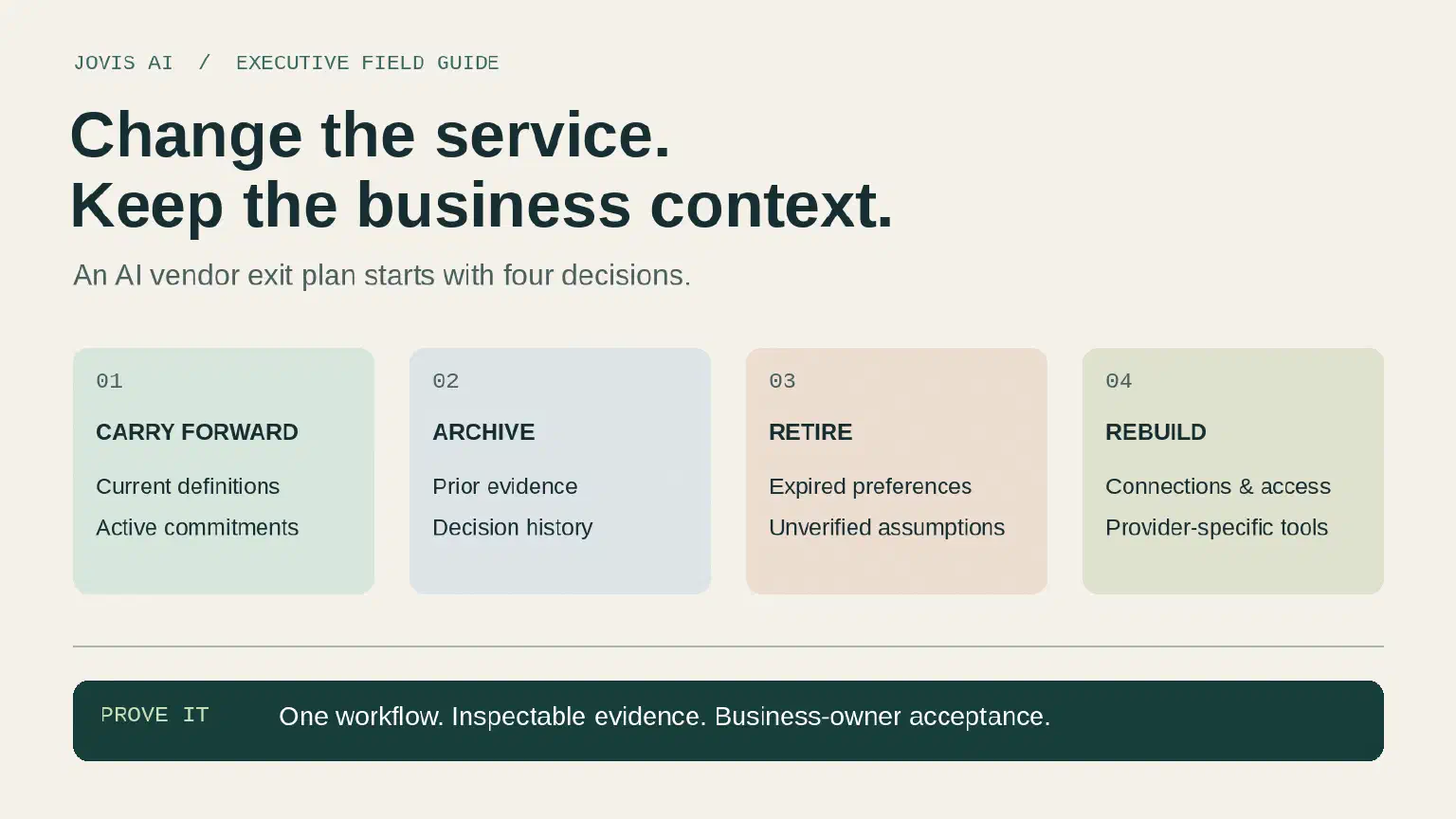
Before renewing an AI service, a CIO and COO should be able to answer a practical question: if we changed providers, could the next leadership review run with the right definitions, evidence, and executive instructions?
An AI vendor exit plan defines what the organization must retain, what must be rebuilt, who authorizes the transition, and how the replacement will prove it can support the business job. A data download is one input. The test is whether the company can use its accumulated context after the switch.
For an executive briefing workflow, that context might include the agreed meaning of a customer at risk, the evidence behind last month’s exceptions, a temporary commercial constraint, and the person authorized to approve outreach. Losing those distinctions can change the recommendations even when every source document survives.
This guide gives executive sponsors a renewal checklist and a rehearsal they can commission. It is general implementation advice, not a claim that Jovis or any named platform provides a complete migration service.
Decide how much dependence the business can accept
An exit plan does not require every AI component to be interchangeable. A service may justify substantial rebuilding work if it delivers enough value and the business can tolerate the transition.
The UK Government Digital Service’s guidance on technical lock-in explicitly balances the value of provider-specific capabilities against portability and switching costs. It recommends estimating time and cost to exit, rather than treating all dependence as unacceptable. That is a useful commercial principle beyond its government-cloud context.
Set the standard by business consequence. A drafting assistant used occasionally may need only a verified archive and a documented replacement process. A workflow that prepares the weekly revenue review needs a tested way to reproduce the required evidence before its next deadline. Maintaining two full production platforms may be unnecessary; a smaller replacement or manual process can be sufficient.
Assign the decision rights clearly:
- The COO or functional executive defines the minimum business output and accepts the replacement’s usefulness.
- The CIO owns the dependency inventory, transition design, and technical verification.
- The CFO and procurement owner review transition costs, contractual access, and the renewal choice.
- Security, privacy, legal, and records specialists review access, permitted reuse, retention, and deletion for the actual context.
The build-versus-buy decision framework addresses which layers to own. An exit plan makes the consequences of that choice concrete after a service has accumulated real operating context.
Sort the context before deciding what to export
Ask the workflow owner to place each important asset into one of four groups. Keep this inventory in an organization-controlled location with appropriate access. A copy inside the departing service alone does not provide an independent exit record.
| Treatment | Examples | Acceptance question |
|---|---|---|
| Carry forward | Current definitions, approved source mappings, active constraints, confirmed commitments | Can the replacement use the meaning, owner, and effective dates? |
| Archive | Prior evidence packets, approvals, superseded plans, historical decisions | Can an authorized reviewer reconstruct the original decision without treating it as current? |
| Retire | Expired preferences, withdrawn instructions, duplicate drafts, unsupported inferences | Has the owner confirmed that these should no longer guide the workflow? |
| Rebuild and test | Provider-specific retrieval indexes, tool connections, routing, authentication, output formatting | Is there an owner, estimate, and acceptance test for the replacement? |
These categories describe intended treatment, not a universal rule about what vendors can export. An asset may need both an archive and a rebuilt working version. Contractual rights and technical availability still need verification.
Australia’s Digital Transformation Agency includes prompts, configuration, metadata, logs, model artifacts, and usable export formats in its portability and exit-planning checklist. It also calls for dependency mapping, transition-cost estimates, and exit tests. The four treatments above are an editorial way to turn that broad inventory into decisions about executive context; the checklist is government guidance, not a universal private-sector requirement.
For every material item, record its owner, source, version, sensitivity, permitted audience, proposed treatment, export evidence, and any rebuild dependency. Mark unavailable items explicitly. Do not let a vendor’s broad “data export supported” answer close an unresolved row.
Preserve the authority behind a remembered preference
Personalization makes this inventory more demanding. “Show me only material exceptions” is incomplete unless the organization knows whose materiality rule applies, which review it governs, and when it was approved.
Consider three statements in an executive assistant’s history:
- “Keep this customer off the routine outreach list until the contract discussion ends.”
- “I prefer a short brief with sources underneath.”
- “The account sponsor seems disengaged.”
The first is a temporary business constraint requiring an owner and a review date. The second is a presentation preference. The third is an interpretation that may be wrong. Copying all three into a new system as standing instructions would erase important differences.
For each remembered instruction, preserve the original source, confirming person, scope, effective period, and expiry or review trigger. Keep inferred context separate from confirmed directions. Have the responsible leader approve which items remain active before the replacement uses them.
That discipline matters to the AI Chief of Staff design vision. Shared context across communication, proactive work, and relationships could spare leaders from repeatedly explaining the same priorities. It also creates a responsibility to distinguish durable preferences from temporary exceptions and private observations. This is a design requirement for such an experience, not evidence that Jovis currently offers portable shared memory.
Verify exports against the exact destination
An export feature can support moving between environments within one platform without supporting migration to another supplier.
For example, Microsoft’s Copilot Studio export and import documentation describes moving agents through solutions between environments. It notes that not every component or property is included and that authentication must be configured again after import. This is a specific platform example, checked on October 30, 2026. It does not establish cross-vendor portability or a Jovis integration.
Ask the implementation owner to demonstrate three separate things:
- Extraction: Can the team obtain the required records and configuration in the agreed window, with documented fields and relationships?
- Interpretation: Can someone outside the current platform understand the export, including identifiers, versions, sources, and access restrictions?
- Use: Can the intended replacement consume or reconstruct enough of it to complete the business job?
A readable file passes only part of that test. A source link that opens solely inside the old workspace may become unusable after account closure. An exported customer ID needs a reliable mapping to the current customer record. A copied prompt may require revision and fresh evaluation in a different system.
Reauthorize connections in the target environment. Recheck the audience for assembled evidence and generated briefs. Do not bundle working credentials into a context archive or assume a new service should inherit all the old service’s access.
Rehearse one leadership review before the renewal deadline
Consider a hypothetical company using an AI service to prepare its Monday customer-risk review. The COO needs a list of accounts requiring a decision, supporting records, open questions, and accountable owners by 9 a.m. Monday.
A rehearsal might reveal that source records are available in company systems, while the approved risk definition lives only in a workspace instruction. A temporary “do not contact” direction survives in a conversation, but its expiry is missing. Last month’s report can be downloaded, yet its evidence links require the departing service’s login.
The next step is to recover and validate those dependencies before testing the replacement. Exporting another copy of the report will not resolve them.
Commission a bounded exercise:
- Fix the reference set. Select a completed review and the evidence available at its original cutoff. Keep the approved outcome and known corrections for comparison.
- Prepare the handover. Reconstruct current definitions and active directions, archive historical material, and identify what needs rebuilding. Limit the exercise to authorized records.
- Run the target path. Prepare the same review in the proposed replacement or interim manual process without relying on access to the old workspace. Have the implementation team record any vendor assistance required.
- Challenge the result. Include an expired instruction, a restricted record, a disputed account match, and a missing source. Check whether each produces the intended response.
- Get business acceptance. Ask the COO whether the packet supports the required decision on time, and ask the CIO whether access and evidence checks passed.
The acceptance standard should preserve meaning and controls. Identical prose is unnecessary. The replacement should identify the material cases supported by the reference evidence, retain unresolved conflicts, and avoid reviving expired directions or exposing restricted records. The business-data agent evaluation guide provides a broader method for building those tests.
A successful rehearsal is evidence about the tested workflow and conditions. It does not prove that every company workflow is ready to move.
Price the work the rehearsal exposes
Use observed gaps to estimate the exit. Include extraction and vendor assistance, configuration rebuilding, identity and source mapping, evaluation, reviewer time, temporary parallel operation, training, and archival access. Separate supplier charges from internal effort.
For example, suppose a hypothetical rehearsal identifies 40 hours of implementation work at an assumed internal cost of $100 per hour, $1,500 of temporary service overlap, and $500 of review effort. The scoped estimate is $6,000, before any unpriced vendor assistance, contract charges, or additional gaps. Those are illustrative assumptions, not market rates or a forecast for another organization.
Record a range where important work is still unknown. Compare it with the value of remaining on the current service and the cost of delaying a switch. A low subscription price can coexist with an expensive transition; accepting that dependence may still be rational if leadership understands it.
This review differs from business continuity planning. Continuity establishes how critical work proceeds through disruption. Exit planning establishes how the organization leaves a provider and retains what it needs. The manual fallback may serve both, but a planned supplier change also needs commercial, archival, and decommissioning decisions.
Give the renewal meeting a concrete decision
Bring a short exit record to the renewal discussion: the business job, minimum output, retained assets, unresolved dependencies, latest rehearsal result, estimated time and cost, named owners, and the next review trigger.
Leadership can then choose to renew with an accepted dependency, require specific remediation, fund a staged transition, or retire the workflow. Agree with counsel and records owners on data-return and deletion arrangements, required retention, transition access, and confirmation evidence. Do not close access or initiate irreversible deletion before the required handover has been verified and authorized.
Jovis’s current product description emphasizes finding relevant business context and preparing leaders for decisions. When evaluating that kind of service, include the context accumulated during use in the exit discussion. The business should be able to explain what it intends to retain and what has actually been tested, even when the best current decision is to stay.