
 Jovis AI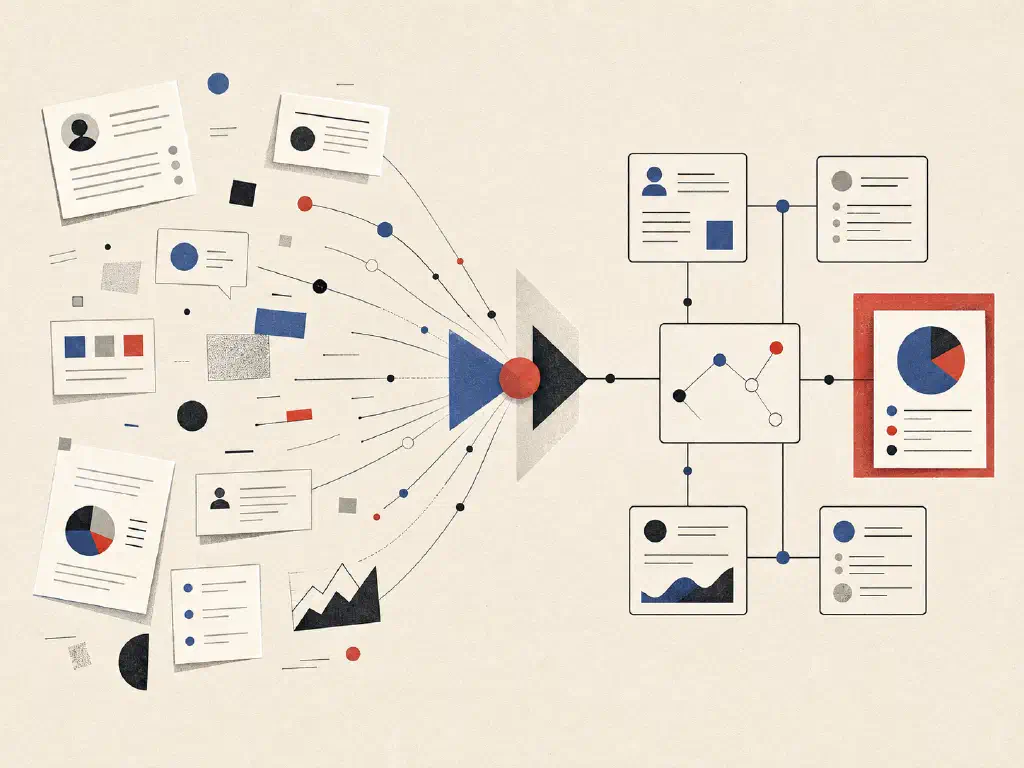
Most companies do not have a data shortage. They have a context shortage.
The CRM has opportunities. The warehouse has transactions. Support has conversations. Product systems have usage events. Yet a manager asking “Why did expansion revenue fall last month?” still needs to know which metric is official, which customers are included, which systems explain the change, and who is allowed to inspect the underlying records.
Business-data context is the information that makes a result interpretable and safe to use: its definition, source, time period, scope, lineage, permissions, related operational events, and known limitations. Without that context, a number can be technically correct and still lead to the wrong decision.
A number can answer the calculation and miss the question
Imagine that net revenue retention declined. The calculation may be clear, but the business question is rarely “What is the arithmetic?” Leaders usually want to know:
- Which segments or accounts explain the movement?
- Was the change caused by churn, contraction, delayed booking, or a definition change?
- Did the pattern begin before or after a product, pricing, or process event?
- Is the movement broad or concentrated?
- Which owner should investigate next?
The metric is the starting point. The useful answer connects it to customers, events, and decisions without obscuring where the evidence came from.
This is one reason more dashboards do not automatically make answers easier to find. A dashboard is effective when the next question was anticipated. Operational work becomes difficult when the reader needs a new cut, another source, or an explanation the fixed view does not contain.
The seven kinds of context a business answer needs
Not every answer needs a full data dictionary or system trace. It does need enough context for the decision’s consequence. These seven dimensions are a practical review model.
1. Definition
State what the term means in this organization. “Active account” could mean a paying account, an account with recent product activity, or an account not marked churned in the CRM. The choice changes the population and therefore the answer.
Record the metric formula, inclusion and exclusion rules, grain, and owner. If two functions legitimately use different definitions, label them by purpose instead of pretending one phrase has a universal meaning.
The semantic layer for AI agents explains how entities, metrics, joins, permissions, and tests can carry this business meaning alongside access to raw tables.
2. Source and lineage
Name the system of record and the transformations between that system and the answer. A source label such as “warehouse” is often too broad. The reader may need to know that the result uses invoiced revenue from finance rather than expected contract value from the CRM.
For a consequential answer, make it possible to inspect the relevant records or query path. The objective is not to turn every manager into a data engineer. It is to let the team resolve disagreement without guessing which dataset was used.
3. Time
Every business result has a clock. State the measurement period, comparison period, timezone when it matters, and freshness of the inputs. “Pipeline this month” can mean opportunities currently expected to close, opportunities that were expected to close at the month’s start, or closed outcomes observed after the month ended.
Time context is especially important when systems update at different cadences. An answer that joins a current CRM state to yesterday’s product snapshot should expose that difference when it could change the interpretation.
4. Scope
Show which entities, regions, products, stages, or customer groups are included. Filters hidden in a dashboard or query often become invisible assumptions in the conversation that follows.
A concise answer might say: “This covers direct enterprise opportunities in North America, excluding renewals and partner-sourced deals.” That sentence prevents the result from being reused as if it represented all pipeline.
5. Permissions
Context also determines what a user may see. Two people can ask the same question and correctly receive different detail because their roles and source permissions differ. An executive summary should not become a route around account-level restrictions.
Permissions should be enforced by identity, application policy, tools, and source systems, not only by instructions to the model. The practical AI-agent permissions and access-control model covers that path in detail.
6. Operational history
Structured records describe state; operational history often explains it. A renewal amount may live in finance while the explanation sits in account notes, support incidents, product usage, or delivery milestones.
This does not mean joining every available system. Select the smallest set that normally changes the interpretation. For a customer-health investigation, recent usage and unresolved support issues may matter. Source-code activity probably does not.
7. Quality and limitations
Make missing records, stale updates, disputed definitions, and low-coverage fields visible. A confident answer that silently drops accounts with missing identifiers is more dangerous than a bounded answer that explains the gap.
Limitations should be specific enough to change behavior: “Two of 38 accounts have no product-usage match because their CRM identifiers are missing” is useful. “Data may be incomplete” is not.
Build a context contract for each recurring question
A context contract is a short, owned specification for the information an investigation requires. It is smaller than an enterprise data model and more operational than a prompt.
For a recurring question, document:
| Field | Example |
|---|---|
| Business job | Find onboarding accounts that need intervention |
| Primary user | Customer-success operations manager |
| Starting population | Accounts in implementation with an open onboarding plan |
| Approved definitions | Stalled = no milestone completion for 10 business days |
| Required sources | CRM, implementation tracker, product usage |
| Optional context | Open support cases and latest account note |
| Freshness | CRM current; usage through previous day |
| Permission rule | User may inspect only assigned region |
| Expected output | Account, evidence, missing context, owner, next review date |
| Failure behavior | Disclose unavailable source; do not infer a stalled state from absence alone |
Review this contract with the business owner, data owner, and access owner. It should be versioned when definitions, systems, or the job changes.
The right connection architecture depends on these requirements. The comparison of four ways to connect AI agents to enterprise data explains the tradeoffs among copied context, retrieval, semantic or query layers, and direct tool access. Choose architecture after defining the job’s freshness, permission, and evidence needs.
Test context with follow-up questions
A single polished answer does not prove that the context is adequate. Test the natural follow-ups an operator would ask:
- “Which customers account for most of the change?”
- “Is this different from the previous period?”
- “What definition did you use?”
- “Which records could not be matched?”
- “Can I inspect the source?”
- “Does this hold for my region?”
If the workflow cannot answer, refuse, or explain its boundary consistently, add context or narrow the job. Follow-ups reveal where an agent is relying on surface language instead of shared business meaning.
Assign context ownership
Context degrades when nobody owns it. The finance team may change a revenue rule. RevOps may rename a stage. Product may retire an event. A joined account identifier may lose coverage after a migration.
Assign owners for metric definitions, source connections, access policy, and the business workflow. Establish a review trigger for schema changes, freshness failures, repeated user corrections, and requests to broaden the agent’s audience. The owner should be able to pause the workflow when its evidence is no longer dependable.
As trusted AI answers require, confidence should come from visible business context and boundaries, not fluent wording.
Make context reusable, not implicit
The goal is not to attach a long disclaimer to every number. It is to encode the definitions, source choices, access rules, and answer structure once, then reuse them across the recurring workflow. That reduces interpretation drift while preserving a path back to evidence.
Jovis brings approved business sources and purpose-defined agents into a governed workspace so teams can ask questions in plain English and inspect grounded answers. The accountable business owner still decides what the evidence means and what action follows. The value of the workspace is keeping the relevant context close enough to support that judgment.