
 Jovis AI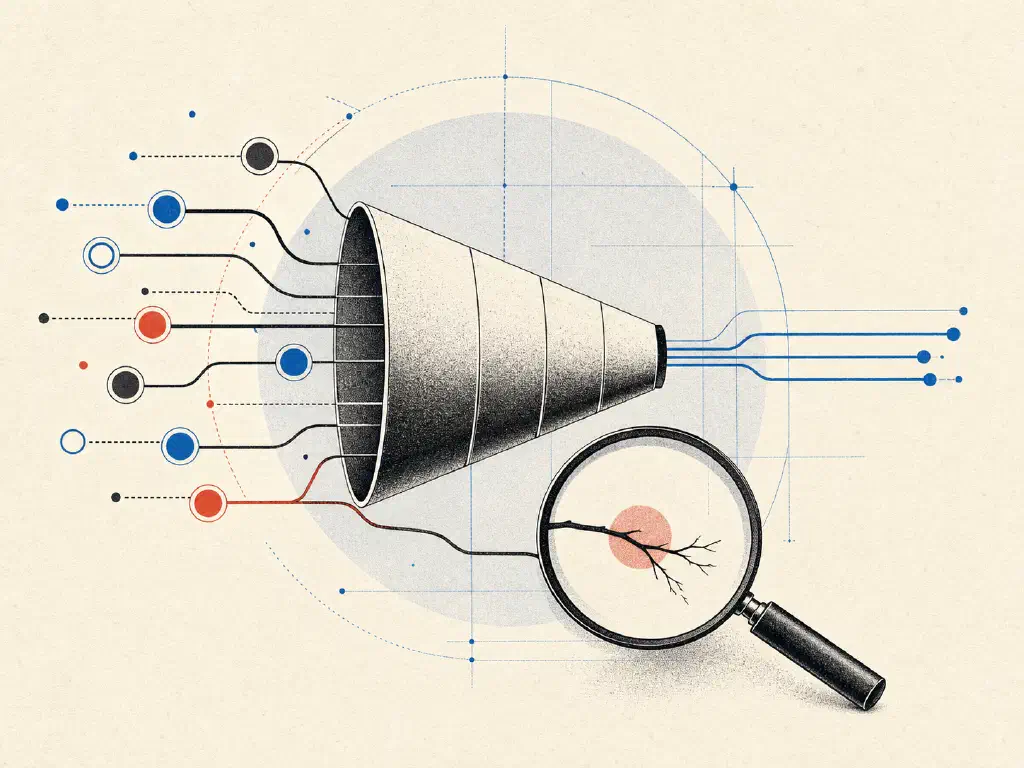
A pipeline number is not a pipeline explanation. Coverage can look healthy while a cluster of late-stage opportunities has gone quiet, moved its close date repeatedly, or lost the customer activity that supported the seller’s last update.
Investigating pipeline risk before the forecast meeting means reviewing the opportunities most likely to change the call, gathering the evidence behind each risk, and assigning the questions that need seller judgment. It does not mean replacing the forecast with a generic risk score.
The useful output is a short exception list: which deals need attention, why they were flagged, what evidence is missing, and who must resolve the uncertainty before or during the review.
Start with the decision the meeting must make
Forecast reviews often mix three jobs:
- decide the most defensible forecast category or range;
- identify customer actions that can improve an outcome;
- improve pipeline hygiene and process discipline.
All three matter, but they require different evidence. A missing next-step date may be a hygiene problem. No customer activity after a commercial proposal may be a deal risk. A systemic concentration of slips in one segment may change the forecast call.
Write down the decision for this review and the time horizon it covers. For example: “Determine whether the current-quarter commit remains supportable and identify late-stage deals requiring an executive or seller action this week.” This prevents the investigation from becoming a long list of every imperfect CRM field.
Define the population before looking for risk
Choose the opportunities that matter for the decision. State the filters in the final readout so the room knows what was and was not examined.
A quarterly commit review might include open new-business and expansion opportunities expected to close this quarter, in specified stages, above a materiality threshold. A manager’s weekly inspection might cover all opportunities expected in the next 45 days.
Preserve the appropriate historical state. A current CRM view can hide the fact that a close date moved several times. If repeated slips are part of the investigation, the workflow needs field history or snapshots rather than only today’s value.
Define business terms as well. “Customer activity” might include an external meeting, a substantive email, or a completed evaluation milestone. It should not automatically treat an internal note update as customer engagement.
Use a small set of explainable risk questions
Begin with questions a revenue leader can inspect and discuss. Tune the thresholds by sales motion, stage, and typical cycle rather than applying one rule to every deal.
Which late-stage opportunities have gone quiet?
Compare time since meaningful customer activity with the expectations for that stage. A quiet period is a prompt to investigate, not proof that the deal is lost. Planned procurement work or an agreed customer deadline may explain it.
The answer should show the last qualifying activity, its date, and any scheduled next interaction. That gives the account owner a fair chance to add context.
Which close dates have moved repeatedly?
Count changes over an appropriate window and preserve the previous dates. One slip after a documented procurement change differs from three slips accompanied by unchanged notes.
Ask whether the revised date is anchored to a customer event, approval, or mutual plan. “End of month” is weaker evidence than “security review completes August 18; final commercial review scheduled August 20.”
Which deals lack a specific next step?
Look beyond whether the CRM field is populated. A useful next step names an action, owner, counterparty, and date. “Follow up” is not equivalent to a scheduled technical validation with named participants.
Because free text can be ambiguous, treat the result as an inspection queue. Show the source note and let the seller or manager confirm the interpretation.
Which opportunities depend on one unverified assumption?
The amount, timeline, buyer authority, technical fit, or approval path may still rest on seller inference. Identify the assumption and the evidence the team expects at the current stage.
This question is more valuable than a blanket “low confidence” label because it tells the room what must be learned next.
Which account signals contradict the deal story?
For expansion and renewal-adjacent work, relevant context may sit outside the CRM. Falling product activity, unresolved support cases, delayed onboarding, or a change in stakeholder participation can contradict an optimistic opportunity update.
Use only sources approved for the workflow, and do not turn an isolated signal into a conclusion. A support case may be routine; falling usage may be seasonal. Attach the evidence so the account team can interpret it.
The process for customer-health monitoring offers a parallel model: detect a change, gather cross-system evidence, expose missing context, and route the investigation to an accountable person.
Build the evidence packet, not just a score
A score can sort opportunities, but the forecast conversation needs reasons. For each flagged opportunity, provide:
| Field | Why it matters |
|---|---|
| Opportunity and owner | Routes the question |
| Amount, stage, and expected close | Shows forecast relevance |
| Risk question triggered | Makes the rule inspectable |
| Evidence and source dates | Supports or challenges the flag |
| Missing context | Prevents false confidence |
| Seller or manager response | Captures business judgment |
| Next action, owner, and date | Turns review into execution |
Keep direct links to the underlying CRM or approved source where permissions allow. A reviewer should be able to inspect a consequential flag without asking an analyst to reconstruct it.
Run the investigation on a fixed cadence
Schedule the first pass early enough for sellers to respond. A practical sequence is:
- Refresh the in-scope opportunity population.
- Run the defined risk questions against approved sources.
- Route exceptions to opportunity owners for confirmation or correction.
- Preserve both the evidence and the owner’s context.
- Bring only unresolved, material items into the forecast review.
- Record the decision and next action.
This changes the room from a status-reading exercise into a decision forum. The pattern is similar to a good AI-enabled weekly business review: gather shared facts before people meet, then spend synchronous time on interpretation, tradeoffs, and ownership.
Do not erase disagreement. If the evidence suggests risk and the seller disagrees, record both views and the next fact that would resolve them. Forecasting is accountable judgment under uncertainty, not an exercise in making every signal consistent.
Test the workflow against past reviews
Use a historical sample before relying on the process. Reconstruct several forecast periods and ask:
- Did the rules surface opportunities the team actually needed to discuss?
- Which flags were technically correct but operationally irrelevant?
- Which important misses reveal a missing source or question?
- Were source dates and opportunity history reconstructed correctly?
- Did access controls prevent inappropriate account detail?
- Could a reviewer explain every flag?
Once live, track whether the exception list is reviewed, whether owners correct source data, whether actions are completed, and whether the same unexplained risks recur. Those measures say more about workflow usefulness than the number of generated flags.
Keep the agent’s role bounded
An agent can assist by gathering records, applying agreed questions, summarizing evidence, and preparing follow-ups. The revenue leader and account owner remain responsible for the forecast call and customer action.
Define what the workflow may read and whether it may write anything back. A first version can remain read-only and produce a review brief. If the team later wants automatic CRM updates or messages, add explicit approvals, auditability, and recovery behavior as a separate change.
This is also a strong example of turning a recurring business question into a useful AI agent: the audience, cadence, sources, answer format, and decision are all concrete enough to evaluate.
Make the forecast meeting the last mile
The goal is not a more elaborate forecast deck. It is to enter the room with the important uncertainty already visible. A good pre-forecast investigation produces fewer rehearsed updates, more specific questions, and a named owner for the next customer action.
Jovis supports teams that want to build this kind of workflow around approved business sources in a governed workspace. It can help gather grounded context and support follow-up questions in plain English. The forecast remains a human decision; the agent makes the investigation easier to repeat and inspect.