
 Jovis AI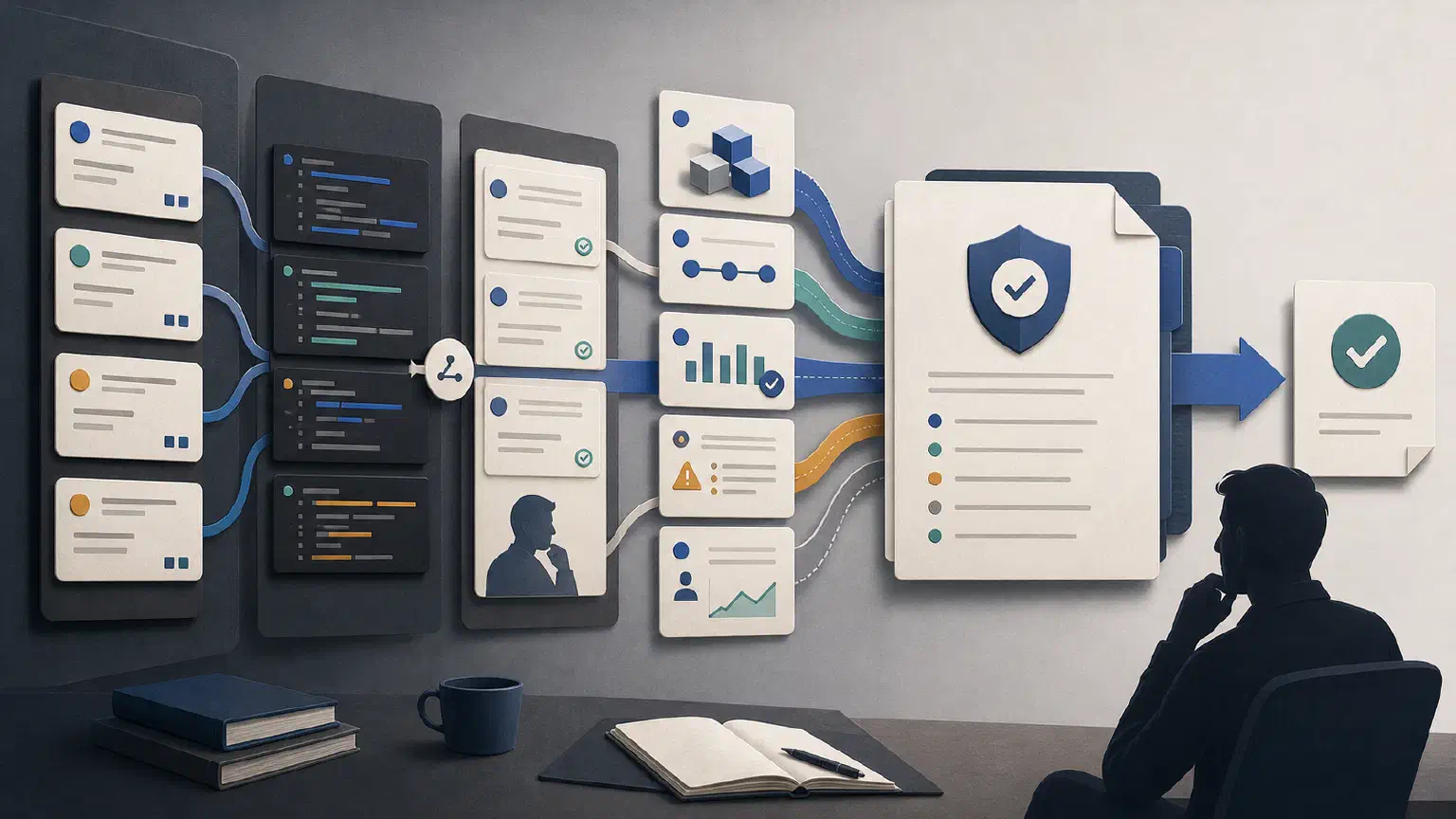
Software delivery risk is the chance that a planned change will miss its commitment, harm users, or leave the team unable to recover safely. You cannot assess it from a roadmap status or a single engineering metric. A useful review connects the commitment to the work in progress, the changes being prepared, the release path, recent operational evidence, and the customers affected.
The output should not be a mysterious red, amber, or green score. It should be a short evidence packet that helps an engineering or product leader choose among a few responsible actions: proceed, reduce scope, add a control, stage the rollout, move the date, or escalate a specific unknown.
Start with the decision, not the delivery dashboard
“Is the release on track?” is too vague. It can mean on time, complete, reliable, secure, recoverable, or ready for a customer commitment. Different interpretations produce different evidence.
Write a review contract for one real decision:
Before Thursday’s release review, identify material risks to the enterprise billing launch, show the delivery and operational evidence behind each risk, and name the person who can resolve or accept it. The product and engineering leads decide whether to proceed, narrow the release, stage it, or change the commitment.
This contract establishes the release, deadline, audience, required evidence, and decision owner. It also prevents the review from becoming a general assessment of team performance.
A useful contract answers five questions:
| Design question | Example |
|---|---|
| What commitment is under review? | Enterprise billing available to an agreed customer cohort |
| When is the last responsible decision point? | Thursday release review |
| What harm are we trying to avoid? | Incorrect invoices, failed upgrades, or an unrecoverable rollout |
| Which evidence is allowed? | Approved work records, code reviews, test and deployment results, incidents, and customer commitments |
| Who accepts the remaining risk? | Named product and engineering owners |
This is the engineering version of starting an operating review with the decisions it owns. Without that boundary, a larger packet usually creates more discussion rather than a better choice.
Build a source map from commitment to consequence
Delivery evidence is spread across systems because each system records a different part of the work. Do not begin by connecting everything. Identify the minimum source for each question and document what it can and cannot prove.
Planned work and scope
The work system can show which items belong to the commitment, their owners, dependencies, state changes, and unresolved decisions. It cannot prove that “90% complete” means the remaining work is low risk. One unresolved migration or approval may matter more than twenty completed tasks.
Capture the agreed scope and its change history. A current snapshot can hide late additions, removed acceptance criteria, or a dependency that moved between teams.
Code and review evidence
The code repository can show whether relevant changes exist, how large and interdependent they are, whether required reviews occurred, and whether work is still arriving near the decision point. Treat commit and pull-request counts as navigation aids, not measures of individual productivity.
That distinction matters. The research behind the SPACE framework for developer productivity argues that productivity cannot be represented by one metric or activity data alone. A delivery review should inspect the change and its context, not rank the people who produced it.
Build, test, and deployment evidence
The delivery system can show whether the release candidate passed the required checks, which environment received it, which exceptions were granted, and whether the same process has worked recently. Record the exact artifact or version under review so evidence from one candidate is not attached to another.
For changes with security or supply-chain consequences, include the evidence required by your own security process. The NIST Secure Software Development Framework treats release integrity, retained release data, and component provenance as explicit practices. It is a risk-based framework, not a universal release checklist; security and compliance owners should determine which controls apply.
Production and recovery evidence
Recent incidents, rollbacks, error-budget pressure, failed deployments, and recovery exercises reveal whether the release enters a stable operating environment. A component with no recent incident may still be risky if ownership is unclear or rollback has never been tested.
DORA’s current software delivery performance metrics cover change lead time, deployment frequency, failed deployment recovery time, change fail rate, and deployment rework rate. Use those measures to understand a team’s delivery system over time. They do not predict whether one specific release is safe.
Customer and business impact
Product commitments, support themes, account obligations, and usage patterns establish who experiences the change and what failure would mean. Label this context carefully. A support conversation can identify a known pain point; it cannot prove that the proposed change fixes it.
If the release follows a recurring customer problem, reuse the evidence discipline from an AI support ticket analysis workflow: define the cohort, preserve representative records, and distinguish a measured theme from an inferred cause.
Investigate five kinds of delivery risk
Once the source map is clear, run the review in a fixed order. The sequence prevents a team from debating release mechanics before it agrees on what is actually being released.
1. Commitment risk
Ask whether the date, customer cohort, acceptance criteria, or dependencies changed. Identify work that is both necessary for the commitment and unresolved. Do not treat every late item equally; show the consequence of leaving it incomplete.
Useful evidence includes scope additions, dependency changes, open product decisions, and acceptance criteria without a verifiable result.
2. Flow risk
Find where required work is waiting. Look for an aging critical change, a review that depends on one unavailable expert, repeated test reruns, or a handoff with no owner. Compare the current path with the team’s normal range rather than imposing a universal threshold.
The DORA guide to software-delivery value streams separates the normal delivery path from the recovery path. That is useful here: a team needs to understand both how the release reaches production and how a corrective change would move if the release fails.
3. Change risk
Inspect what makes the change difficult to validate or reverse. Examples include a large coupled change, an irreversible data migration, a new dependency, an untested permission boundary, or a mismatch between the reviewed and deployable artifact.
The right response is not automatically another meeting. DORA’s guidance on streamlining change approval favors peer review and automated feedback inside the delivery process over a heavyweight external approval at the end. Add scrutiny where the evidence calls for it, but avoid creating a late gate that encourages larger batches.
4. Operational risk
Check whether the team can detect harm, stop the rollout, and restore service. Name the signals that would trigger a pause. Confirm the owner, rollback or mitigation path, and any dependency on another team.
When progressive delivery is available and appropriate, a canary can limit initial exposure while the team compares the change with a control. Google’s SRE guidance on canarying releases defines a canary as a partial, time-limited deployment evaluated before a broader rollout. It is one control, not evidence that the release is safe by itself.
5. Consequence risk
Finally, connect a plausible failure to affected customers, operations, revenue commitments, or regulatory obligations. Separate the likelihood from the impact. A rare failure with an irreversible outcome may deserve more control than a common, quickly reversible defect.
This step keeps the review tied to business responsibility. It also makes prioritization more defensible when several technical risks compete for attention.
Produce an evidence packet, not a risk score
For every material finding, include:
- the commitment or release component affected;
- the observed fact and its source;
- the definition, time window, and artifact version used;
- why the fact could affect the commitment;
- what remains unknown;
- the proposed control or decision;
- one owner and a decision deadline.
Keep fact, hypothesis, and decision visually separate. “Three required changes are awaiting review” is an observed fact. “The specialist reviewer may become a bottleneck” is a hypothesis. “Move one reviewer from the platform team today” is a decision.
This structure gives leaders something they can challenge. It also creates a traceable record after the release. If a risk materializes, the team can see whether the evidence was missing, misunderstood, accepted, or ignored.
Give AI the investigation work, not the release authority
An AI agent can help assemble this packet when the job and source boundaries are explicit. It can collect approved evidence, reconcile identifiers across systems, compare the current release with relevant history, surface missing context, and prepare a reviewable brief.
It should not infer that a release is safe because the visible checks are green. Nor should it turn activity data into judgments about individual engineers. The agent’s role is to shorten the path from a delivery concern to inspectable evidence. The accountable product, engineering, security, or operations owner makes the release decision.
Each run should retain enough context to reconstruct the sources, definitions, tool results, and reviewer outcome. The broader AI agent observability model explains how to trace that path without treating a fluent final answer as proof that the workflow worked.
Run a four-week pilot on one commitment
Week 1: define the contract. Choose one release or delivery commitment. Name the decision owners, consequences, approved sources, decision point, and evidence requirements.
Week 2: build the source map. Connect each review question to an authoritative source. Resolve identifiers, freshness expectations, and access boundaries. Document gaps rather than filling them with assumptions.
Week 3: rehearse failure. Test a late scope change, a missing review, a stale deployment result, an inaccessible incident record, and a release candidate that no longer matches its evidence. Confirm that the workflow shows the limitation and routes it to an owner.
Week 4: run beside the current review. Compare the evidence packet with the existing status meeting. Record which risks were useful, which were noise, which questions still required manual investigation, and whether the resulting decision was clearer.
Jovis can bring approved code repositories, business systems, support context, and documents into a shared, permission-aware workspace for this kind of recurring investigation. Start with one consequential release. Success is not a perfect prediction. It is a review in which the right people can see what changed, inspect what supports the concern, and make the next decision before the commitment becomes an incident.