
 Jovis AI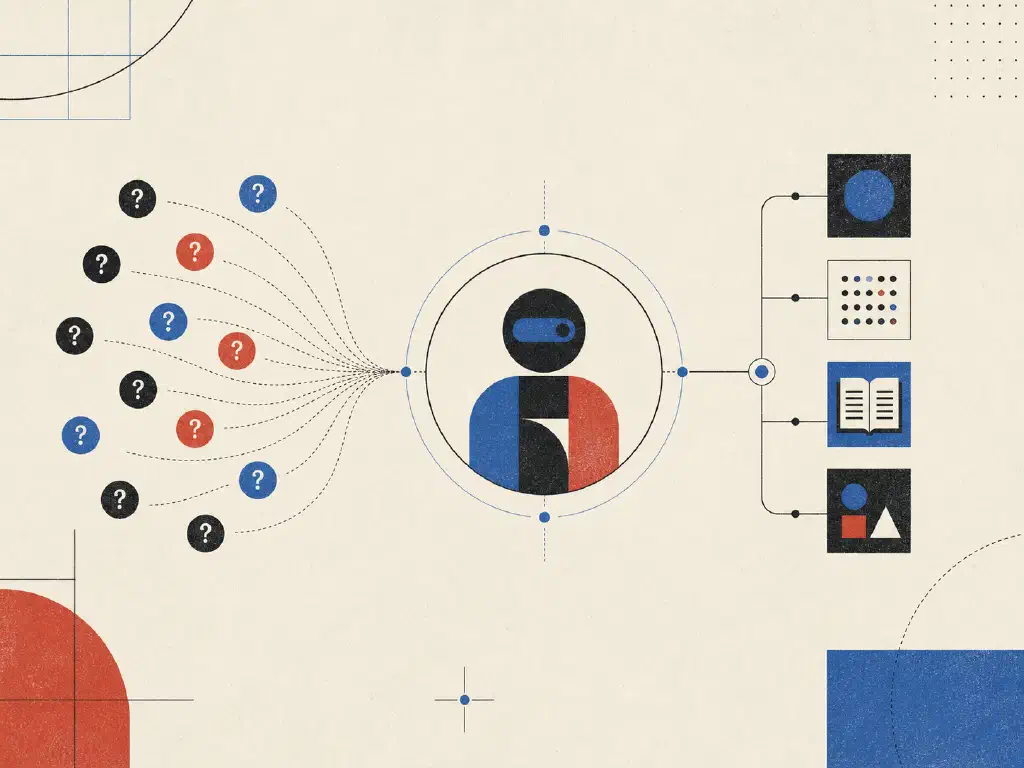
The best first AI-agent use case is usually not hiding in a strategy workshop. It is already visible in the questions people repeat in Slack, operating reviews, spreadsheets, and the data team’s request queue.
“Which onboarding accounts are stalled?” is a useful candidate. It names a recognizable business state and points toward an action. “Give everyone an AI assistant” is not. It describes an interface without defining the job, sources, owner, or standard for a good result.
To turn a recurring business question into a useful AI agent, select one question that is frequent, consequential, and supported by trusted data. Then define its business decision, source boundary, answer format, evaluation set, and accountable owner. The output should become a repeatable investigation, not merely a faster one-off answer.
Start with a question inventory, not an idea list
Collect real questions for two weeks. Ask business partners and analysts to forward or tag requests rather than reconstructing them from memory. Useful places to look include:
- weekly operating-review preparation;
- recurring spreadsheet and slide updates;
- Slack threads that end with “can someone check?”;
- dashboard questions that trigger a manual drill-down;
- data and analytics tickets;
- customer, pipeline, support, or delivery escalations.
Record the question in the language the requester used. Add who asked, how often it occurs, which decision followed, who answered, what sources were needed, and what made the answer difficult. This evidence prevents a loud but rare request from displacing a smaller question that slows the team every week.
Score candidates by business usefulness
Use a simple 1-to-3 score across five criteria:
| Criterion | Question to ask |
|---|---|
| Frequency | Does this occur weekly or during a predictable event? |
| Consequence | Does the answer change a decision, owner, or next action? |
| Source readiness | Are the necessary systems available and trusted for this job? |
| Repeatability | Can the team describe what a good investigation normally checks? |
| Risk | Can the first version operate with bounded, mostly read-only access? |
A good first agent does not need the highest theoretical value. It needs enough value to matter and enough structure to learn safely.
Consider two examples. “Draft our annual market strategy” is consequential, but infrequent and hard to evaluate. “Which enterprise trials have no product activity in five business days?” is frequent, sourceable, and connected to a named follow-up. The second is a stronger first workflow even if the first sounds more ambitious.
This selection process also protects the data team. As the data team is not a search engine argues, small questions consume attention because they require source knowledge and judgment, not because the SQL is necessarily difficult. Reusing that work is more valuable than making the request form prettier.
Write the agent’s job in one sentence
Use this template:
Help [specific user] answer [recurring question] using [approved sources] at [cadence or trigger], so they can [decision or action]. Do not [important boundary].
For example:
Help customer-success managers identify onboarding accounts that may be stalled each Monday using approved CRM, product-usage, and support data, so they can assign the right follow-up. Do not contact customers or change account records.
The sentence reveals unresolved choices. If the user is “everyone,” the sources are “all company data,” or the action is “make better decisions,” the job needs another pass.
The same narrow-job principle appears in how to build an AI agent a team will use. Adoption depends less on a large catalogue of capabilities than on whether the agent reliably helps with work people already recognize.
Map the investigation before configuring the agent
Sit with the person who answers the question today. Ask them to narrate the work, including checks that feel obvious to an expert. Map:
- Which records start the investigation?
- Which filters and definitions decide what is in scope?
- Which other systems provide confirming or contradictory context?
- Which exceptions require human judgment?
- What evidence must appear in the answer?
- What action does the reader take next?
For the onboarding example, a manager might begin with accounts in implementation, check milestone dates, compare recent product activity, scan unresolved support issues, and review the latest customer note. The answer should show why an account was flagged, not simply label it “at risk.”
This is where many agent projects discover that the question spans several systems. That does not automatically make it unsuitable. It means the team must define which source is authoritative for each part of the answer and what happens when one source is unavailable.
Design an answer that supports a decision
Specify the result before refining the prompt. A useful operational answer often includes:
- the period and population reviewed;
- a short direct answer;
- the records that need attention;
- evidence behind each finding;
- missing or stale context;
- an owner or recommended next step;
- links back to the source records where appropriate.
Avoid defaulting to a long narrative. A table may work for an exception list; a short brief may work for an operating review. The format should help the primary reader decide what to inspect or do next.
A strong answer should also support follow-up questions. “Is this concentrated in one segment?” and “What changed since last week?” are not scope creep when they are natural parts of the same investigation. Record them during testing because they expose missing definitions and source context.
Build a representative test set
Before inviting a broad user group, create 15 to 30 examples from past work. Include normal cases, ambiguous requests, missing data, restricted records, contradictory sources, and questions outside the defined job. Remove or protect sensitive information according to your policies.
Review each result for:
- correct interpretation of the question;
- appropriate source selection;
- evidence that supports the conclusion;
- permission behavior;
- visible uncertainty and limitations;
- usefulness of the proposed next step.
The detailed guide to evaluating an AI agent before business-data access shows how to turn these cases into launch criteria. The point is not to prove that the model can answer something once. It is to define the conditions under which the workflow is reliable enough for its job.
Pilot in the meeting where the question matters
Introduce the agent inside the existing operating rhythm. If the question prepares a Monday customer review, use it there. If it supports forecast inspection, use it before that meeting. A separate “AI demo hour” may generate enthusiasm, but it does not show whether the workflow survives contact with the real decision.
During a four-to-six-week pilot, track a small set of observations:
- Did the intended users return without prompting?
- Which questions still required an analyst?
- Which definitions or source gaps caused corrections?
- Did the answer lead to a named action?
- Did users inspect the evidence when the result was consequential?
The approach in an AI-enabled weekly business review is a helpful model: prepare the shared facts before the meeting so the room can spend more time on causes, choices, and owners.
Keep an owner after launch
Assign a business owner who can judge whether the answer still helps the intended decision. Assign a technical owner for source connections, access, and runtime behavior. Their review should cover failed questions, changed definitions, stale sources, user corrections, and requests to broaden scope.
Retire an agent when the underlying question disappears, the source is no longer trustworthy, or the workflow cannot meet its acceptance criteria. A growing catalogue of unused agents is not evidence of adoption.
A useful agent starts with a useful question
At the end of the process, you should be able to point to one repeated question, one primary user, one bounded source set, one decision, one test set, and one owner. If those elements are missing, adding more model capability will not fix the workflow.
Jovis is designed for this middle ground. Teams can organize approved business sources in a governed workspace, define agents around a business job, inspect grounded answers, and share the workflow with the people who need it. Human owners remain responsible for the judgment and action that follow.